What Can You Supplement on a Roof Claim? 12 Items Contractors Commonly Request
Kelvin Spratt
Founder, Supplement Snap · October 25, 2026 · Updated October 25, 2026
Key Takeaways
Common items roofers request in a supplement, from decking to flashing and drip edge, and what to document. Coverage depends on the policy and carrier.
Preparing a supplement? Use the free checklist so nothing is missing when you submit.
The short answer
Contractors commonly request a supplement for work that was not in the carrier's first estimate because it could not be seen until the old roof came off. The usual categories are damaged decking, flashing, drip edge, ice and water protection and underlayment, starter and ridge or hip cap, vents and pipe boots, extra layers of roofing, steep or high-roof work, permits and code items, and debris removal. Whether any of them is paid depends on the policy, the cause of loss, local rules and the carrier, so each needs documentation.
Disclosure: we make Supplement Snap, which helps roofing crews document damage found at tear-off and export a report. It does not decide coverage, negotiate claims or guarantee approval. This page is general guidance, not legal or claims advice.
Free download
Roof tear-off findings log
A log for the roof: where each finding is, what it is, how much, and which photos show it, with a checklist before you leave.
Fillable PDF: open it in a PDF reader such as Adobe Acrobat Reader to type into the blanks. Some phone and browser previews cannot.
See all free roofing templates →
No email or sign-up needed. General guidance, not legal advice. Adjust it to your carrier's, client's and state's requirements.
The 12 items, and what to document
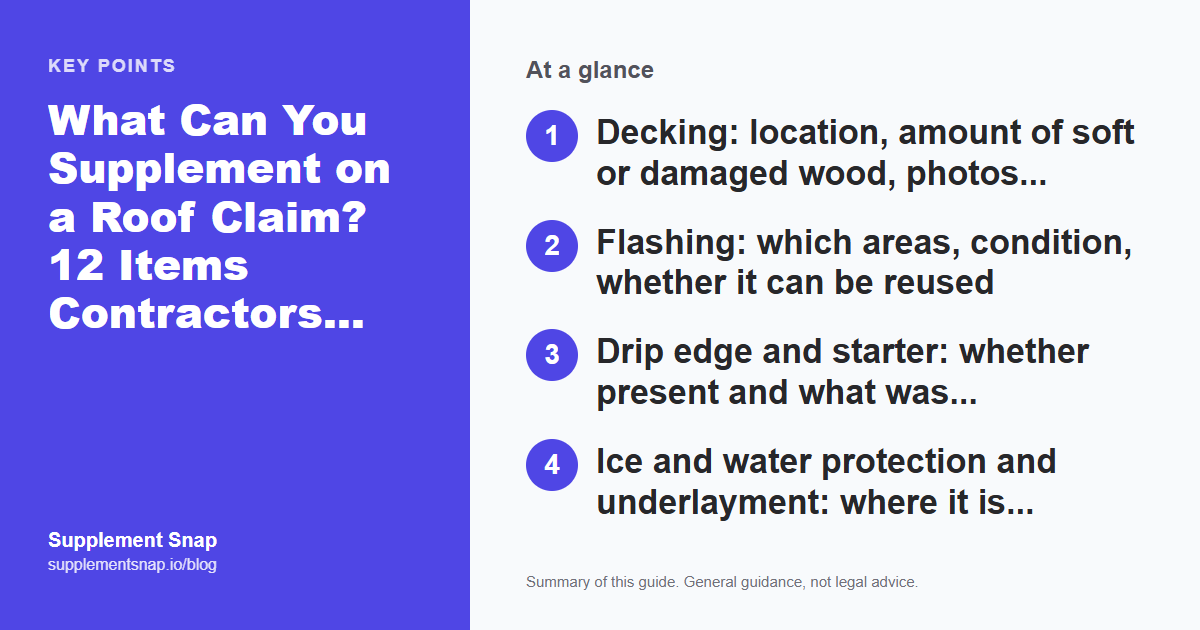
The table covers the main groups. For each one, the strongest request shows where it is, what you found, how much of it there is, and photos that match.
| Feature | What to document | Often depends on |
|---|---|---|
| Decking: location, amount of soft or damaged wood, photos up close and wide | Cause of damage, policy terms and the carrier's estimate | |
| Flashing: which areas, condition, whether it can be reused | Scope of the original estimate and local practice | |
| Drip edge and starter: whether present and what was installed | Carrier guidelines and local code | |
| Ice and water protection and underlayment: where it is needed or missing | Climate, local code and the carrier's scope | |
| Vents and pipe boots: count and condition | What the original estimate included | |
| Extra layers and steep or high work: number of layers, pitch, stories | Measurements and the carrier's pricing |
Found something under the shingles?
Supplement Snap helps your crew photograph and describe each finding at tear-off so it is ready to send. Your first project is free.
1 to 4: Decking, flashing, drip edge and underlayment
<strong>Decking</strong> is the most common hidden finding. Soft, rotted or damaged sheathing is only visible after tear-off, so photograph it before anything new goes on, with a tape measure or marked area for scale. See our guide to documenting rotted decking at tear-off.
<strong>Flashing</strong> around chimneys, walls and valleys may be damaged or missing. Note which areas and whether it can be reused.
<strong>Drip edge</strong> and <strong>underlayment</strong> (including ice and water protection) depend heavily on local code and the carrier's guidelines. Record what was there, what you installed and why.
5 to 8: Starter, ridge and hip cap, vents, pipe boots
<strong>Starter</strong> and <strong>ridge or hip cap</strong> are part of a complete roof installation and are sometimes left out of an estimate. <strong>Vents</strong> and <strong>pipe boots</strong> are small items that add up. Count them and photograph each type. Our Xactimate codes guide explains how these items are listed in an estimate.
Coverage is not automatic
Every item on this list can be accepted, reduced or denied depending on the policy, the cause of loss, local code and the carrier. The goal is to document what you found, not to assume it will be paid.
9 to 12: Extra layers, steep or high work, permits and code items, debris removal
<strong>Extra layers</strong> of old roofing mean more tear-off and disposal. Note the number of layers and photograph the edge. <strong>Steep or high-roof work</strong> depends on measured pitch and stories, so record both. <strong>Permits and code items</strong> vary a lot by place and policy, and some policies include limited code coverage. See code upgrades and ordinance and law coverage. <strong>Debris removal</strong> and disposal should match what was actually hauled.
How to present these in a request
Group the items into findings, give each one a location, a quantity and photo numbers, and write a plain sentence on what was found and when. Avoid guessing at causes you cannot prove. The supplement email template and the photo documentation checklist help you assemble it.
Where Supplement Snap fits
Supplement Snap lets your crew photograph each finding on the roof, tag the damage type and roof area, add a typed or voice note, review the drafted description and export a PDF for the adjuster. It does not decide what is covered. Your first project is free. See the pricing page.
Frequently asked questions
What can you supplement on a roof claim?
Items that were not in the carrier's first estimate, commonly decking, flashing, drip edge, ice and water protection, underlayment, starter and cap, vents, extra layers, steep or high work, permits and code items, and debris removal. Payment depends on the policy and carrier.
What is the most common roofing supplement item?
Damaged decking is among the most common, because it cannot be seen until the old roof is removed. Document it with photos and measurements before new materials go on.
Will the insurance company pay for everything I request?
Not automatically. Each item can be accepted, reduced or denied depending on the policy, the cause of loss, local code and the carrier. Good documentation makes it easier to review.
Do I need photos for every supplement item?
Photos with locations and scale are the main proof, plus a short description and quantity. Record items before they are covered by new materials.
Where do I find the Xactimate codes for these items?
See our guide to Xactimate codes for roofing supplements. Codes and pricing vary by carrier and region, so match the format the adjuster uses.
References & Resources
Free tools and resources
Ready to streamline your supplement process?
Supplement Snap helps your crew capture hidden damage during tear-off and generate adjuster-ready reports in minutes.
Written by
Kelvin Spratt
Founder, Supplement Snap
Kelvin builds software for roofing contractors who are tired of leaving supplement money on the table. His background in software development and insurance restoration workflows drives everything Supplement Snap does.