Rotted Fascia on a Roof Claim: How to Document It at Tear-Off
Kelvin Spratt
Founder, Supplement Snap · October 25, 2026 · Updated October 26, 2026
Key Takeaways
Dropping the gutters can reveal rotted fascia and rafter tails the estimate never saw. How to photograph, measure and describe it factually for the carrier.
Preparing a supplement? Use the free checklist so nothing is missing when you submit.
The short answer
Fascia, sub-fascia and rafter tails sit behind the gutters, so their condition is often unknown until the gutters come off during a replacement. When the crew finds rot there, the job has gained work that was not in the first estimate. The way to handle it is to stop, photograph and measure while it is exposed, describe it plainly without guessing at the cause, and send it to the office the same day. The carrier decides whether it is covered.
Disclosure: we make Supplement Snap, which helps roofing crews document damage found at tear-off and export a report. It does not decide coverage, negotiate claims or guarantee approval. This page is general guidance, not legal or claims advice.
Free download
Roof tear-off findings log
A log for the roof: where each finding is, what it is, how much, and which photos show it, with a checklist before you leave.
Fillable PDF: open it in a PDF reader such as Adobe Acrobat Reader to type into the blanks. Some phone and browser previews cannot.
See all free roofing templates →
No email or sign-up needed. General guidance, not legal advice. Adjust it to your carrier's, client's and state's requirements.
Why it shows up late
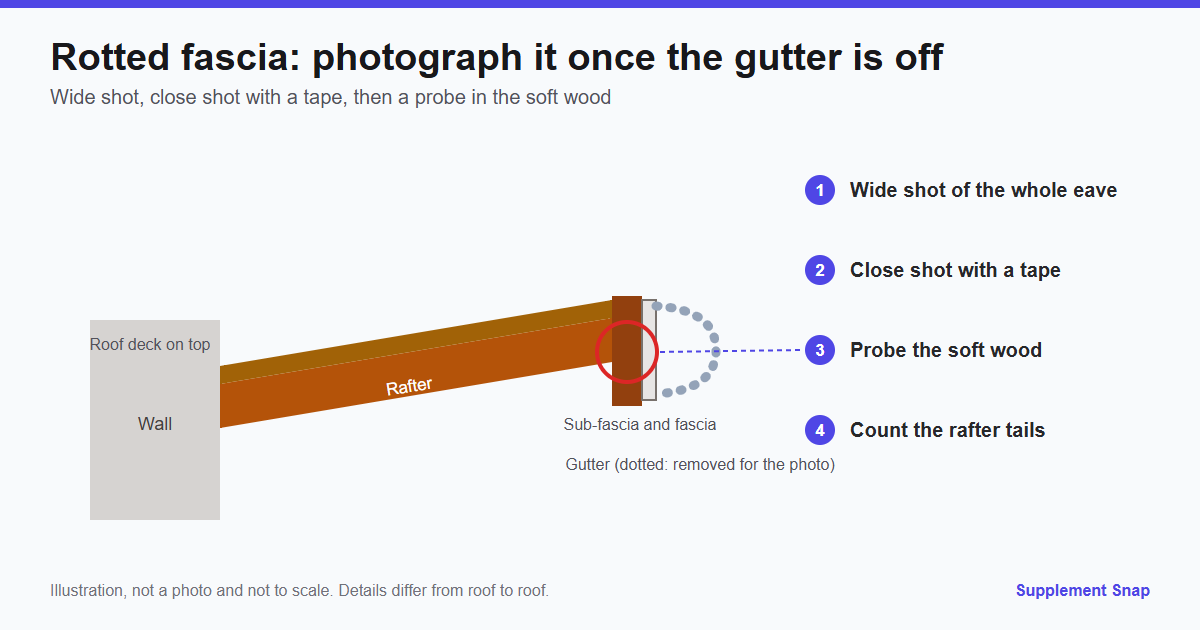
Gutters and drip edge cover the fascia, and the sub-fascia and rafter tails are behind it. Water that runs down the back of a gutter or sits against the eave can soften wood out of sight. An adjuster inspecting from the ground or from aerial images usually cannot see it. The table lists what to capture the moment the board is exposed.
| Feature | What to capture |
|---|---|
| The wide shot | The whole eave or rake, showing where along the roof the damage is |
| The close shot | The rotted board with a tape, and a probe or screwdriver showing how soft it is |
| The length | Linear feet of fascia, and how many rafter tails look affected |
| What is behind it | The gutter attachment and the edge of the roof deck, if exposed |
| The date | When the gutters came off, so the finding is tied to the tear-off |
Log it before the gutters go back up.
Supplement Snap helps your crew capture each finding with a photo, a location and a note while the damage is still exposed. Your first project is free.
Step 1: Wide shot, then close shot
Take a photo of the whole eave or rake first, so a reviewer can see where the damage is. Then move in: photograph the rotted board with a tape against it. If it is soft, press a screwdriver or a probe into it and photograph that, because it shows condition better than a description.
Step 2: Measure and count
Write the linear feet of fascia that is affected, and how many rafter tails look soft. Note which side of the house and which part of the eave. Our findings log has a row for each, with photo numbers.
State what you see, not the cause
Say the board is soft and discolored and where. Whether it is storm damage, old moisture or maintenance is for the carrier and the policy to decide, and a guess weakens your credibility.
Step 3: Describe it without guessing
A short factual note works: Front eave, left side. About 14 linear feet of fascia is soft and discolored when probed. Three rafter tails show deterioration at the end. Found after gutters were removed. Photos 18 to 23.
Avoid words like neglected, old or storm damage unless you can show the evidence. Leave the cause to the reviewer.
Step 4: Send it before the repair
Do not replace the board before the office has the photos. If the work cannot wait because of weather or safety, photograph it thoroughly first and tell the office what you did. If you need the carrier's approval before replacing it, send the photos right away and follow up. Building codes, manufacturer instructions, policy wording and carrier practice vary, so confirm the details for your job with the building department and the claim documents.
A worked example (fictional)
On a full replacement, the crew removes the gutters on the front eave and finds that a length of fascia crumbles at the lower edge. The lead photographs the eave, then the board with a tape, then a screwdriver sinking into the wood. He counts three rafter tails with the same condition, writes it in the log, and calls the office.
The office builds a numbered finding for fascia and another for the rafter tails, attaches the photos and asks the carrier to review the added work. The numbers and details are invented to show the process, and the carrier may decide differently.
How to word the request
Fascia and rafter tails, front eave: 14 linear feet of fascia and 3 rafter tails soft and deteriorated, found after gutter removal. Photos 18 to 23 show the condition with a tape and probe. Replacement requested for the affected sections.
Keep fascia and rafter tails as separate findings so the reviewer can answer each on its own.
Fascia, sub-fascia, soffit and rafter tails: what is what
Fascia: the board that runs along the edge of the roof, usually where the gutter attaches
Sub-fascia (also called a fascia backer in some regions): a board behind the fascia that gives it something solid to fasten to
Rafter tails: the ends of the rafters that stick out past the wall
Soffit: the underside of the overhang, between the wall and the fascia
Use the same words in your photos and notes so a reviewer knows exactly which board you mean.
A copy-and-paste checklist
Wide photo of the whole eave or rake
Close photo of each bad section with a tape
Photo of a screwdriver or probe pressed into the soft wood
Linear feet of fascia affected, written down
Count of rafter tails that look soft
Which side of the house and where along it
A note that the gutters were removed and when
A photo of anything unusual behind the gutter, such as old water staining
Safety first
Dropping gutters and working at the eave puts crews at the edge of the roof. Follow your fall protection rules and do not lean out to get a photograph. If a rafter tail is badly deteriorated, treat the edge as unsafe until it is braced or replaced. A good photo is not worth an injury.
What if the damage is small or hard to judge
Not every soft spot is a finding. If the board is sound and only stained, say so honestly. If a section is soft but small, record the length and let the reviewer decide. Overstating a minor spot weakens the rest of your package. Our supplement mistakes guide covers how that happens.
Mistakes to avoid
Replacing the board before photographing it
Writing a cause you cannot show
One photo of a whole eave with no close shot
No length or count
Sending the request weeks later, after the exposed wood is covered
Frequently asked questions
Does insurance cover rotted fascia?
It depends on the policy, the cause and the carrier's review. Document what you find and ask. Do not promise the homeowner that it will be covered.
What is sub-fascia?
The board behind the fascia that the gutter and fascia attach to. It is also called a fascia backer or sub-fascia depending on the region.
How do I show how soft the wood is?
Photograph a screwdriver or probe pressed into it, with a tape alongside for size.
Should I replace it before the carrier agrees?
Photograph it thoroughly first and tell the office. If you must proceed for safety or weather, document what you did and why.
How do I avoid blaming the cause?
Describe condition and location only. The reviewer decides cause.
Can this be part of a supplement?
Many contractors list it as its own numbered finding with photos and a quantity. The carrier decides what to pay.
What is the difference between fascia and soffit?
Fascia is the board along the roof's edge where the gutter attaches. Soffit is the underside of the overhang. They are different parts and are usually priced separately, so photograph and list each.
Who pays for rotted fascia, the homeowner or insurance?
That depends on the policy, the cause and the carrier's review. Document what you find and tell the homeowner it is for the carrier to decide.
Can shingles be replaced without replacing fascia?
Often yes, if the fascia is sound. If it is soft or damaged, the edge detail and gutter attachment may need repair first. Photograph the condition and note the work needed.
References & Resources
Free tools and resources
Ready to streamline your supplement process?
Supplement Snap helps your crew capture hidden damage during tear-off and generate adjuster-ready reports in minutes.
Written by
Kelvin Spratt
Founder, Supplement Snap
Kelvin builds software for roofing contractors who are tired of leaving supplement money on the table. His background in software development and insurance restoration workflows drives everything Supplement Snap does.
More Articles
How to Document Rotted Roof Decking Found During Tear-Off
Read more →
What Can You Supplement on a Roof Claim? 12 Items Contractors Commonly Request
Read more →
Roof Tear-Off Findings Log Template (Free PDF and Word)
Read more →
Roofing Photo Documentation Checklist: What to Photograph at Tear-Off
Read more →