What Is a Supplemental Roofing Estimate? When It Applies and What It Includes
Kelvin Spratt
Founder, Supplement Snap · October 23, 2026 · Updated October 25, 2026
Key Takeaways
A supplemental roofing estimate asks the insurer to cover damage found after the first estimate. Learn when it applies, what it includes, and how to submit one.
Preparing a supplement? Use the free checklist so nothing is missing when you submit.
What a supplemental roofing estimate is
A supplemental roofing estimate, usually called a roofing supplement, is a request sent to an insurance company for additional costs that were not in the original claim estimate. It is most often needed when work begins and the crew finds damage or conditions that could not be seen before the old roof came off.
The insurer decides whether the items are covered. A supplement is a documented request, not a guaranteed payment.
Free download
Roofing supplement template
The five-part package: cover page, findings summary, findings with photo numbers, line items and sign-off, plus a before-you-send checklist.
Fillable PDF: open it in a PDF reader such as Adobe Acrobat Reader to type into the blanks. Some phone and browser previews cannot.
See all free roofing templates →
No email or sign-up needed. General guidance, not legal advice. Adjust it to your carrier's, client's and state's requirements.
Why the first estimate is often incomplete
The first estimate is usually written from an inspection of the roof surface, sometimes with aerial measurements. Anything under the shingles is invisible at that point.
Common reasons a supplement comes up:
Decking: Soft or rotted boards found after tear-off.
Flashing: Corroded or failed flashing at chimneys, walls and valleys.
Underlayment and ice and water shield: Conditions that differ from what the estimate assumed.
Quantities: Measurements or counts that differ from the original estimate.
Code or manufacturer requirements: Items required for the repair that were left out.
Capture this on the roof, not from memory.
Supplement Snap lets your crew take photos and voice notes at tear-off and drafts a report you review before sending. Your first project is free.
What a supplement request should include
Adjusters respond best to a package they can verify quickly:
Claim details: Carrier, claim number, date of loss and adjuster.
Findings: Each item described factually, with its location.
Photos: Wide and close-up shots taken before the condition was covered.
Measurements: Quantities that match the notes and the line items.
Line items: Which estimate items each finding supports.
Supporting documents: Measurement reports, invoices or code references where relevant.
Use the free roofing supplement checklist to confirm nothing is missing, and see the sample report for the format.
How the process usually runs
The crew finds a condition during tear-off and photographs it.
The contractor notifies the adjuster and documents the finding.
The contractor submits the supplement package.
The adjuster reviews it, may request more information or reinspect, and then approves, adjusts or denies the items.
The contractor follows up and records the outcome.
Timelines and requirements vary by carrier and claim. If a request is denied, read the stated reason and see what to do when a supplement is denied.
Doing it yourself or using software
Plenty of contractors write supplements by hand. The slow parts are matching photos to findings and building a clean report. Roofing supplement software like Supplement Snap helps with exactly that: you capture and describe findings on the roof, and it assembles the report for the adjuster. Compare approaches in software vs. spreadsheets.
No tool can guarantee coverage or approval. That depends on the claim, the policy and the carrier. For the full walkthrough, read how to write a roofing supplement.
Supplemental estimate, supplement and change order: what is the difference?
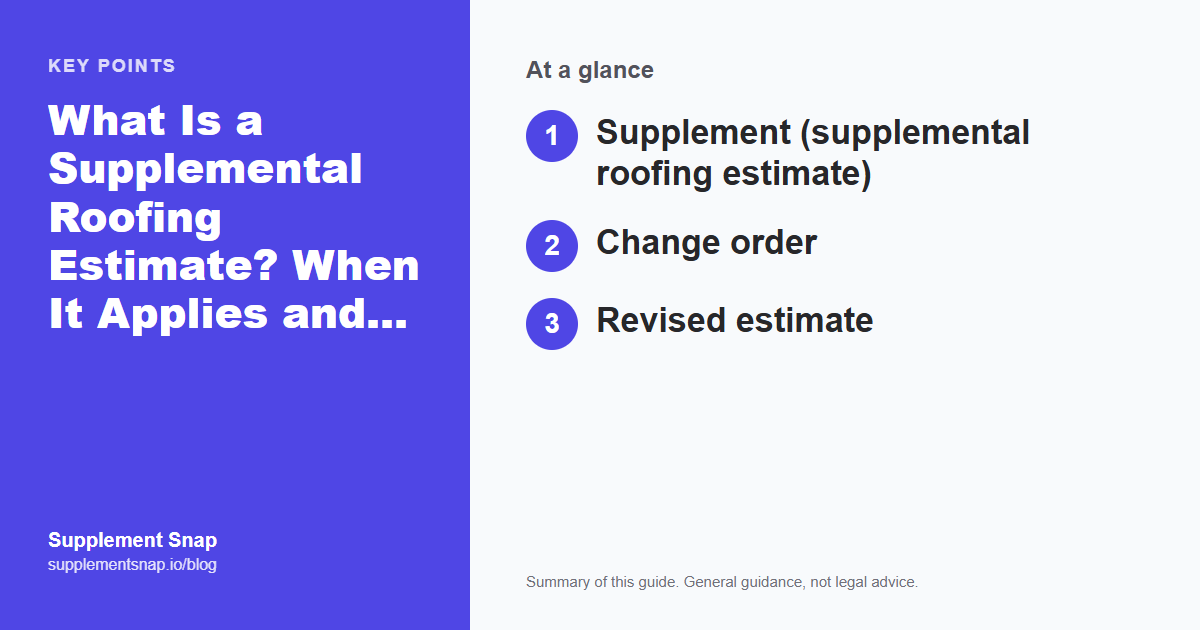
People use these words loosely, so it helps to separate them. A supplemental roofing estimate, usually called a supplement, is sent to the insurance carrier to request payment for items missing from the original claim estimate. A change order is an agreement between the contractor and the property owner that changes the scope or price of the job. A revised estimate is what the carrier issues after it reviews a supplement or reinspects the roof.
In insurance work, supplement and supplemental mean the same request. The table shows how they differ from the other terms.
| Feature | Who it goes to | What it does |
|---|---|---|
| Supplement (supplemental roofing estimate) | The insurance carrier | Requests payment for items missing from the original estimate |
| Change order | The property owner | Changes the scope or price of the contractor's agreement |
| Revised estimate | Issued by the carrier | Shows what the carrier approved after reviewing a supplement or reinspecting |
A fictional example
This example is made up to show the idea, and the quantities are not typical of any real claim.
The carrier's estimate covers tear-off and new shingles on a two-slope roof. During tear-off, the crew finds three sheets of soft decking on the rear slope and no drip edge along one eave. The crew photographs each area with a tape measure in the frame, notes where it is and when it was found, and records the quantities. The supplement then lists two findings, decking and drip edge, each with its location, quantity, photo numbers and a plain description, in the format the adjuster uses. The adjuster reviews it and decides what to approve.
The point is the evidence: what was found, where, how much, and proof that it was not visible before work began. See a sample supplement report.
How to request one, step by step
Document hidden damage before new materials cover it, with wide and close photos and a measurement.
Write each finding as a location, a quantity and a plain description, without guessing at causes you cannot show.
Put the findings and line items in one organized PDF with the claim number on the first page.
Email it to the adjuster with a short note, using our <a href='/blog/roofing-supplement-email-to-adjuster'>supplement email template</a>.
Note a follow-up date and track every contact in a <a href='/blog/roofing-supplement-follow-up-log'>follow-up log</a>.
If it is denied or reduced, see <a href='/blog/roofing-supplement-denied-what-to-do'>what to do next</a>.
The list of common supplement items shows what contractors typically check for, and how long a supplement takes explains the timing.
Frequently asked questions
What is a supplemental roofing estimate?
It is a request to the insurance company for additional costs not included in the original estimate, usually because damage or conditions were discovered after work started.
Who submits a roofing supplement?
Usually the roofing contractor, with documentation of what was found. The insurer decides whether to approve the items.
Is a roofing supplement guaranteed to be approved?
No. Approval depends on the claim, the policy, the carrier and the documentation provided.
How long does a supplement take?
It varies by carrier and claim. Complete, organized documentation helps avoid back-and-forth requests for more information.
Is a supplemental estimate the same as a supplement?
Yes. In roofing insurance claims, supplement, supplemental estimate and supplemental roofing estimate all describe a request for payment for items missing from the carrier's original estimate.
What is the difference between a supplement and a change order?
A supplement is a request to the insurance carrier. A change order is an agreement between the contractor and the property owner that changes the scope or price of the work.
Can a homeowner request a supplement?
The policyholder can ask the carrier to review additional damage, and contractors often prepare the documentation. Who may submit or negotiate varies by state, so see our guide on what contractors may and may not do on a claim.
What should I do if the carrier denies the supplement?
Ask for the reason in writing, review your documentation, and consider a reinspection or other options in the policy. See our guide on what to do when a supplement is denied.
Free tools and resources
Ready to streamline your supplement process?
Supplement Snap helps your crew capture hidden damage during tear-off and generate adjuster-ready reports in minutes.
Written by
Kelvin Spratt
Founder, Supplement Snap
Kelvin builds software for roofing contractors who are tired of leaving supplement money on the table. His background in software development and insurance restoration workflows drives everything Supplement Snap does.
More Articles
How to Write a Roofing Supplement That Gets Approved
Read more →
How to Write a Roofing Supplement Request Email to an Adjuster (With Template)
Read more →
What Can You Supplement on a Roof Claim? 12 Items Contractors Commonly Request
Read more →
Roofing Supplement Denied? Here's What to Do Next
Read more →