Drip Edge on a Roof Claim: How Roofers Document and Request It
Kelvin Spratt
Founder, Supplement Snap · October 25, 2026 · Updated October 25, 2026
Key Takeaways
Drip edge is a common line item roofers ask carriers to include. Learn how to check local code, document it with photos, and request it in a supplement.
Preparing a supplement? Use the free checklist so nothing is missing when you submit.
The short answer
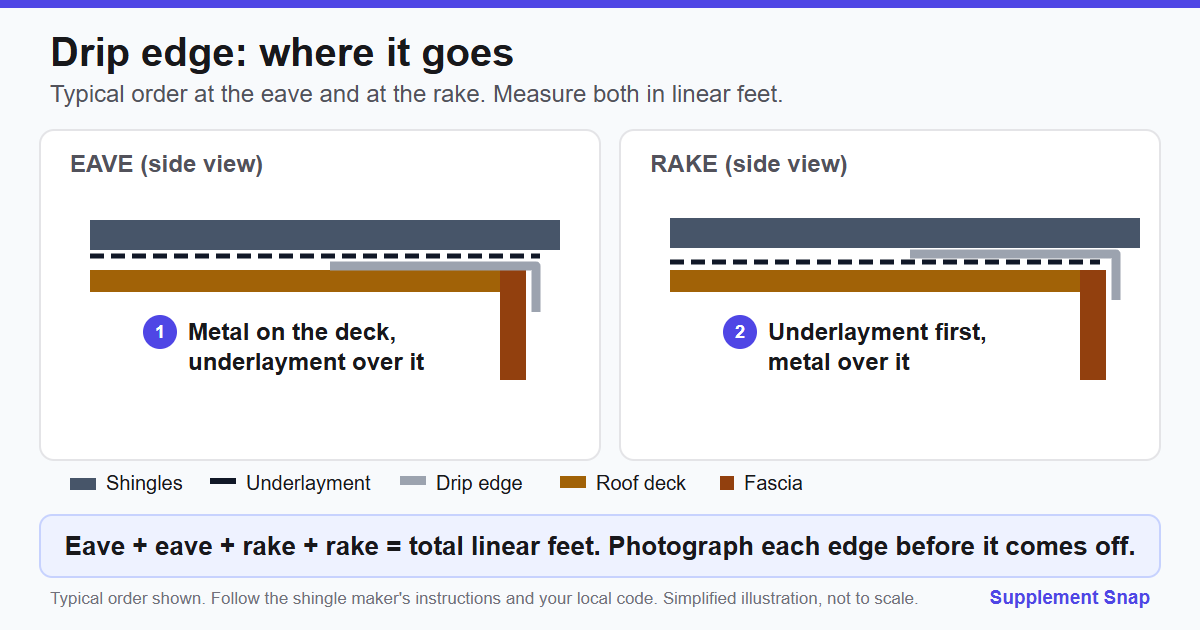
Drip edge is the metal flashing installed along the eaves and rakes of a roof so water drips clear of the fascia and decking. On an insurance job, roofers often ask the carrier to include it when the estimate leaves it out or counts too little of it. Whether the carrier pays depends on the policy, local code and what you can show.
The practical approach is the same for any supplement item: check what code requires locally, measure the linear feet, photograph what is there before it comes off, and put the request in writing with the evidence attached.
Disclosure: we make Supplement Snap, which helps roofing crews document damage found at tear-off and export a report. It does not decide coverage, negotiate claims or guarantee approval. This page is general guidance, not legal or claims advice.
Free download
Roof tear-off findings log
A log for the roof: where each finding is, what it is, how much, and which photos show it, with a checklist before you leave.
Fillable PDF: open it in a PDF reader such as Adobe Acrobat Reader to type into the blanks. Some phone and browser previews cannot.
See all free roofing templates →
No email or sign-up needed. General guidance, not legal advice. Adjust it to your carrier's, client's and state's requirements.
What the carrier needs to see
The table lists the questions an adjuster is likely to ask. Answer them in your documentation before they are asked. A request that says add drip edge is easy to set aside. A request that shows the edges, the measurements and the local requirement is easier to review.
| Feature | Why it matters on a claim |
|---|---|
| Is there existing drip edge? | Photos of the eave and rake before tear-off show whether metal edging is already there or missing |
| Does local code call for it? | Many places have adopted a version of the International Residential Code that calls for it on asphalt shingle roofs; the building department can confirm |
| Is it in the carrier estimate? | Compare the estimate to your measured eave and rake lengths and note any difference |
| What do you measure? | Linear feet of eave and rake, written next to the photos |
Prove the drip edge, not just ask for it.
Supplement Snap helps your crew photograph edges before and after tear-off and export a report tied to each finding. Your first project is free.
How to document it on the roof
Take wide photos of each eave and rake before tear-off so the existing edge, or the lack of one, is visible. Take a close photo where the shingles meet the edge. After tear-off, photograph the bare decking edge so it is clear what is being installed.
Write down the linear feet for each edge and add them up. Show your arithmetic, for example 42 ft + 42 ft for two eaves and 30 ft + 30 ft for two rakes. Keep photo numbers beside each measurement.
Where code fits in
Carriers commonly pay for work required to bring a repair up to code only if the policy says so, so a code requirement does not always mean payment. The model residential code is published by the International Code Council, and local governments adopt it on their own schedules and often change it. Building codes, policy wording and carrier practice vary by state, county and policy. Confirm the details for your job with the local building department and the claim documents.
If the requirement matters to your request, say which edition your jurisdiction uses and quote or attach what the building department told you. Do not state a code section from memory.
Check your local code first
The model residential code has required drip edge at eaves and rakes under asphalt shingles since the 2012 edition, with the wording changing in later editions. Many local governments have adopted a different edition or amended it. Ask your building department which edition applies before you cite it.
How to word the request
Keep it factual: the location, the measured length, what was found, and what you are asking to be included. For example: Drip edge, all eaves and rakes, 144 linear feet measured at tear-off. Photos 3 to 9 show the edges before removal. Local code reference attached.
Avoid arguing about what the adjuster should have done. Put the evidence on the page and make the next step easy to take.
Mistakes that slow it down
Asking for drip edge with no photos of the edges
Giving a total length with no way to check it
Quoting a code edition your jurisdiction has not adopted
Mixing it into a long email instead of listing it as a numbered finding
Not saying whether the edge was missing, damaged or only being replaced as part of the job
A worked example (fictional numbers)
Say a crew tears off a gable roof with two eaves of 44 feet each and two rakes of 31 feet each. Before tear-off, the lead photographs each edge and sees no metal edging under the first course of shingles on either rake. The measurements are 44 + 44 + 31 + 31 = 150 linear feet.
The carrier's estimate lists 88 linear feet, which covers the eaves only. The contractor's request would then list the difference as its own numbered finding: 62 linear feet at the rakes, with photos of both rakes before removal, the tape reading for each rake and, if the local building department has confirmed a requirement, the written note. Everything the adjuster needs to say yes, no or ask a question is on one page.
The numbers above are made up to show the format. Use your own measurements and the carrier's own figures.
What to say when the roof had drip edge already
Often the old roof has some drip edge. That changes the request. If the existing metal is intact and can be reused, the carrier may reasonably ask why it is being replaced. If it is bent, rusted through, the wrong profile for the new roof, or was only installed on part of the roof, say so and show it in a photo.
Write what you actually saw, for example: Existing drip edge present at eaves only, rusted through at three locations (photos 4 to 6). None at rakes (photos 7 and 8). Avoid saying the old edge was non-compliant unless the building department has told you so in writing.
Questions an adjuster or desk reviewer may ask
Where is the measurement from, and can I see the photos for each edge?
Did the old roof have drip edge, and what was its condition?
Is this a local code requirement, and in what edition or amendment?
Is the item already included under another line in the estimate?
If you can answer all four on the page before they are asked, the request is faster to review. If you cannot answer one of them, say that too, and say how you will find out.
Keeping the file clean
Name the photos by edge, such as rake-left-before and rake-left-after, or number them and keep a list. Keep the building department's reply in the same folder as the claim. Record the date you sent the request and the date you plan to follow up. If you use Supplement Snap, the finding, its photos and its quantity stay together in the project and export as one PDF, but the same discipline works with any tool or a folder on a laptop.
Frequently asked questions
Does insurance pay for drip edge?
Sometimes. It depends on the policy, the local code and the carrier's review. Many carriers include it in a replacement estimate, and others leave it out and wait for a request with documentation.
Is drip edge required by code?
The model residential code has called for it at eaves and rakes under asphalt shingles since the 2012 edition, but local adoption varies. Ask your building department which edition and amendments apply.
How do I measure drip edge?
Measure the linear feet along each eave and rake with a tape or a measuring tool, write each length down, and add them. Keep the numbers next to the photos.
Should I photograph the old drip edge?
Yes, before it is removed. Photos show whether it existed, what shape it was in and where it sat.
Can I request it in a supplement after the first estimate?
Many contractors do when the estimate leaves it out. Send it with your photos and measurements and follow the carrier's process.
What if the building department will not give me anything in writing?
Note the date, the person you spoke with and what they said, and say plainly in the request that it was a phone conversation. You can also ask the homeowner's insurance agent or the carrier which documentation they accept.
Should drip edge be a separate line from the shingles?
List it as its own finding with its own quantity so it can be accepted or questioned on its own. If the carrier's estimate combines it with other items, say which line you compared against.
References & Resources
Free tools and resources
Ready to streamline your supplement process?
Supplement Snap helps your crew capture hidden damage during tear-off and generate adjuster-ready reports in minutes.
Written by
Kelvin Spratt
Founder, Supplement Snap
Kelvin builds software for roofing contractors who are tired of leaving supplement money on the table. His background in software development and insurance restoration workflows drives everything Supplement Snap does.
More Articles
What Can You Supplement on a Roof Claim? 12 Items Contractors Commonly Request
Read more →
Xactimate Codes for Roofing Supplements: Quick Reference
Read more →
How to Write a Roofing Supplement That Gets Approved
Read more →
How to Write a Roofing Supplement Request Email to an Adjuster (With Template)
Read more →