How to Build an Xactimate Roof Estimate for Insurance Supplements
Kelvin Spratt
Founder, Supplement Snap · March 7, 2026
Sample Supplement Total
$1,438
Typical supplement value using standard Xactimate codes + O&P
Key Takeaways
Learn how to build an Xactimate roof estimate for insurance supplements. Covers key line codes like RFG SHTHN, RFG FLSH, RFG I&WS, pricing benchmarks, and common mistakes that get supplements denied.
What is Xactimate and why does it matter for roofing supplements?
Xactimate is the insurance industry's standard software for estimating property damage repair costs. Developed by Verisk, it is used by the vast majority of insurance carriers, independent adjusters, and third-party administrators to write estimates for roofing claims. When an adjuster inspects storm damage on a roof, they enter their findings into Xactimate using standardized line codes, unit prices, and quantities to produce the claim estimate.
For roofing contractors, Xactimate matters because it is the language adjusters speak. When you submit a supplement (a request for additional payment for hidden damage found during tear-off), the adjuster needs to process that request within Xactimate. If your supplement is written in Xactimate's format with the correct line codes and pricing, the adjuster can review and approve it quickly. If your supplement is a vague description with a few photos and no reference to Xactimate codes, the adjuster has to do extra work to translate your findings, which often results in lower approvals, longer processing times, or outright denials.
You don't need to own an Xactimate license to submit supplements in Xactimate format. What you need is knowledge of the relevant line codes, current unit pricing, and how to structure your findings so the adjuster can process them efficiently.
How adjusters use Xactimate to write roof estimates
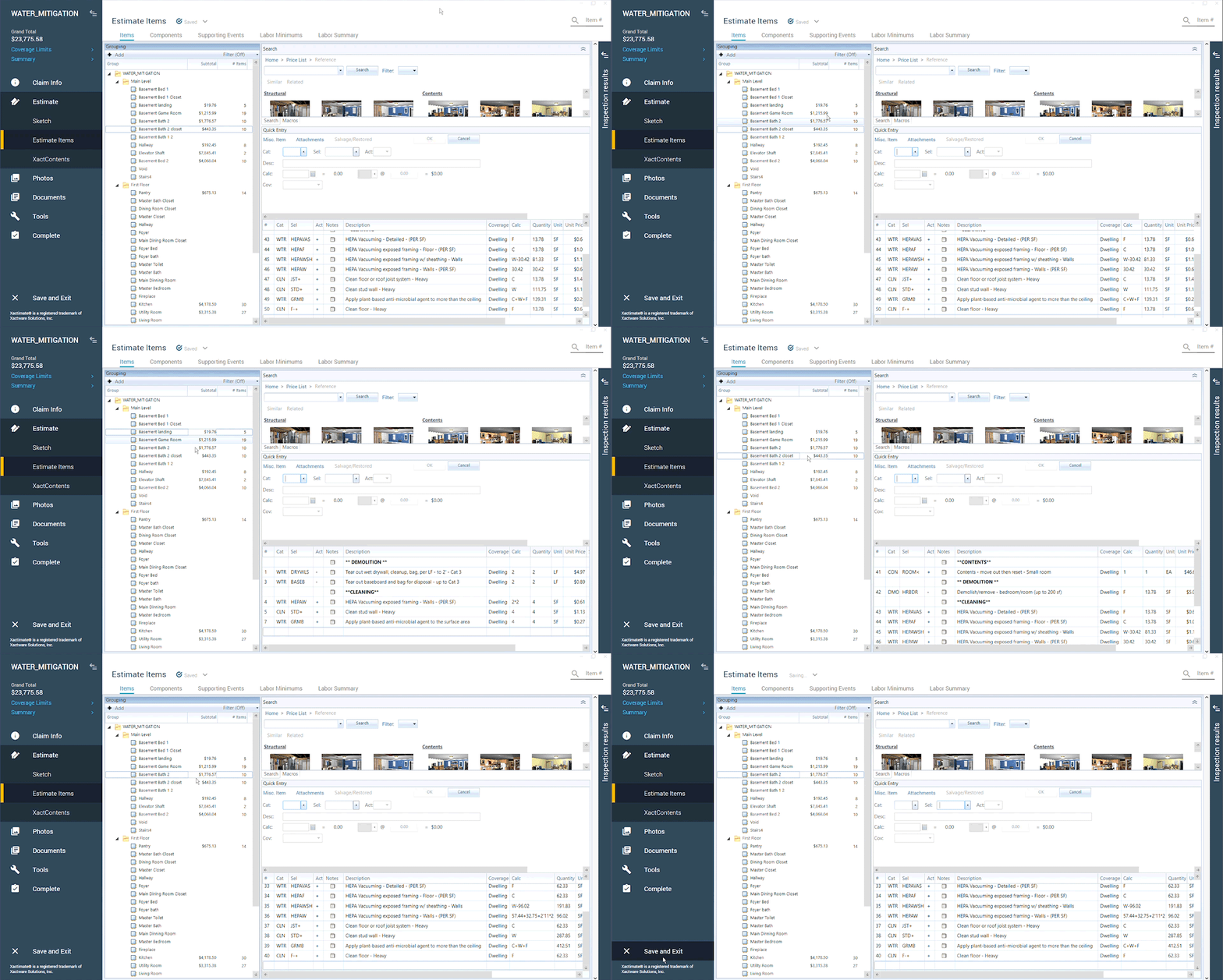
Understanding how adjusters use Xactimate helps you write better supplements. When an adjuster inspects a roof for storm damage, they follow a systematic process:
They measure the roof or use a measurement report (EagleView, Hover, etc.)
They inspect the roof surface for hail impacts, wind damage, or other covered perils
They enter their findings into Xactimate as line items, each with a specific code, quantity, and unit price
Xactimate calculates overhead and profit (O&P) on top of the line items, typically 10% overhead and 10% profit
The software generates a detailed estimate that becomes the basis for the claim payment
The adjuster's Xactimate estimate only includes what they could see during their inspection. They walked the roof, noted visible damage, and wrote line items for the repairs they observed. They did not tear off the shingles. They did not inspect the decking underneath. They did not check the condition of the flashing behind the step metal or the integrity of the ice and water shield in the valleys.
This is exactly why supplements exist. The adjuster's estimate is based on a surface inspection. Your supplement adds the concealed damage that only becomes visible during tear-off. The more closely your supplement mirrors the adjuster's Xactimate format, the easier it is for them to approve the additional items.
Essential Xactimate line codes for roofing supplements
Every supplement item maps to a specific Xactimate line code. Here are the most common codes you'll use, along with current national average pricing. Note that Xactimate prices vary by region and are updated quarterly, so always check current pricing for your area.
RFG SHTHN — Sheathing, plywood/OSB, remove and replace. The code for replacing rotted or damaged roof decking. Unit: SF (square feet). National average: approximately $2.18/SF. A standard 4x8 sheet is 32 SF, so one sheet runs roughly $70. This is the single most common supplement line item.
RFG FLSH — Flashing, step/counter, aluminum, remove and replace. Used for corroded or damaged step flashing at chimneys, walls, and dormers. Unit: LF (linear feet). National average: approximately $8.75/LF.
RFG I&WS — Ice and water shield membrane, install. Used when ice and water shield is missing in code-required areas or has deteriorated. Unit: SF. National average: approximately $1.85/SF. This item often requires a building code reference in your narrative.
RFG VENT — Roof vent, pipe jack/boot, remove and replace. Used for cracked or deteriorated pipe boots. Unit: EA (each). National average: approximately $85/EA.
RFG DRIP — Drip edge, aluminum, remove and replace. Used when drip edge is missing or damaged. Unit: LF. National average: approximately $4.25/LF.
RFG TEAR — Remove additional layer of roofing. Used when a second or third layer is discovered during tear-off. Unit: SQ (100 SF). National average: approximately $45/SQ.
Building a supplement estimate in Xactimate format
You don't need to own Xactimate to submit a professional supplement. What you need is a structured document that mirrors the Xactimate format so the adjuster can process it quickly.
For each finding, include these elements:
Line code: the Xactimate code (e.g., RFG SHTHN)
Description: the standard Xactimate description (e.g., 'Sheathing - plywood/OSB - R&R')
Quantity: the measured amount in the correct unit (e.g., 96 SF)
Unit: SF, LF, EA, or SQ as appropriate
Unit price: current Xactimate pricing for your region
Line total: quantity multiplied by unit price
Here's what a sample supplement estimate looks like:
RFG SHTHN — Sheathing, plywood/OSB, R&R — 96 SF × $2.18 = $209.28
RFG FLSH — Step flashing, aluminum, R&R — 24 LF × $8.75 = $210.00
RFG I&WS — Ice & water shield, install — 180 SF × $1.85 = $333.00
RFG VENT — Pipe boot, R&R — 3 EA × $85.00 = $255.00
RFG DRIP — Drip edge, aluminum, R&R — 45 LF × $4.25 = $191.25
Subtotal: $1,198.53
O&P (20%): $239.71
Total Supplement: $1,438.24
This level of specificity makes it easy for the adjuster to review and approve. Compare this to a supplement that just says 'additional decking and flashing needed - $1,500.' Which version gets approved faster?
Pricing benchmarks and regional variations
Xactimate pricing is not fixed nationally. Verisk updates pricing quarterly based on regional labor rates and material costs. Prices are set by zip code, so a contractor in Dallas will see different unit prices than one in Minneapolis.
Approximate national average ranges for the most common supplement items (as of early 2026):
RFG SHTHN (decking): $2.00–$2.50/SF depending on region
RFG FLSH (step flashing): $7.50–$10.00/LF
RFG I&WS (ice & water shield): $1.60–$2.20/SF
RFG VENT (pipe boot): $75–$100/EA
RFG DRIP (drip edge): $3.75–$5.00/LF
RFG TEAR (additional layer removal): $38–$55/SQ
When submitting a supplement, use the pricing for your specific region. If you price above the Xactimate rate for your zip code, the adjuster will adjust it down. If you price below, you're leaving money on the table.
Also keep in mind that overhead and profit (O&P) is a separate discussion. Most insurance claims include 10% overhead and 10% profit on top of the line item totals. If the original claim includes O&P, your supplement should also include it.
Mistakes that get Xactimate supplements denied
Even with the right line codes and pricing, supplements get denied for avoidable mistakes:
Wrong quantities: Claiming 5 sheets of decking when your photos only show 2 damaged areas. Adjusters cross-reference your quantities against the photos. Always measure carefully and photograph every area you're claiming.
Missing documentation: Submitting line items without supporting photos or a narrative. The adjuster needs to justify the additional payment to their supervisor. Give them the evidence they need.
Using incorrect codes: Selecting the wrong Xactimate code changes the unit price and signals you don't know what you're doing. Know your codes.
Not explaining concealment: Your narrative must clearly state that the damage was concealed beneath existing roofing materials and was discovered during tear-off operations. Without this, the adjuster may argue it should have been caught during the initial inspection.
Late submission: Submitting a supplement three weeks after tear-off raises questions. Why did it take so long? Has the damage been covered by new materials? Submit the same day whenever possible.
Inflated pricing: Submitting prices above the current Xactimate rate for your region signals you're padding the estimate and makes the adjuster scrutinize every line item.
How Supplement Snap generates Xactimate-ready exports
Building an Xactimate-formatted supplement manually for every job takes time: looking up line codes, checking pricing, formatting the estimate, writing the narrative, organizing photos. It's the kind of work that either falls on your office staff or doesn't get done at all.
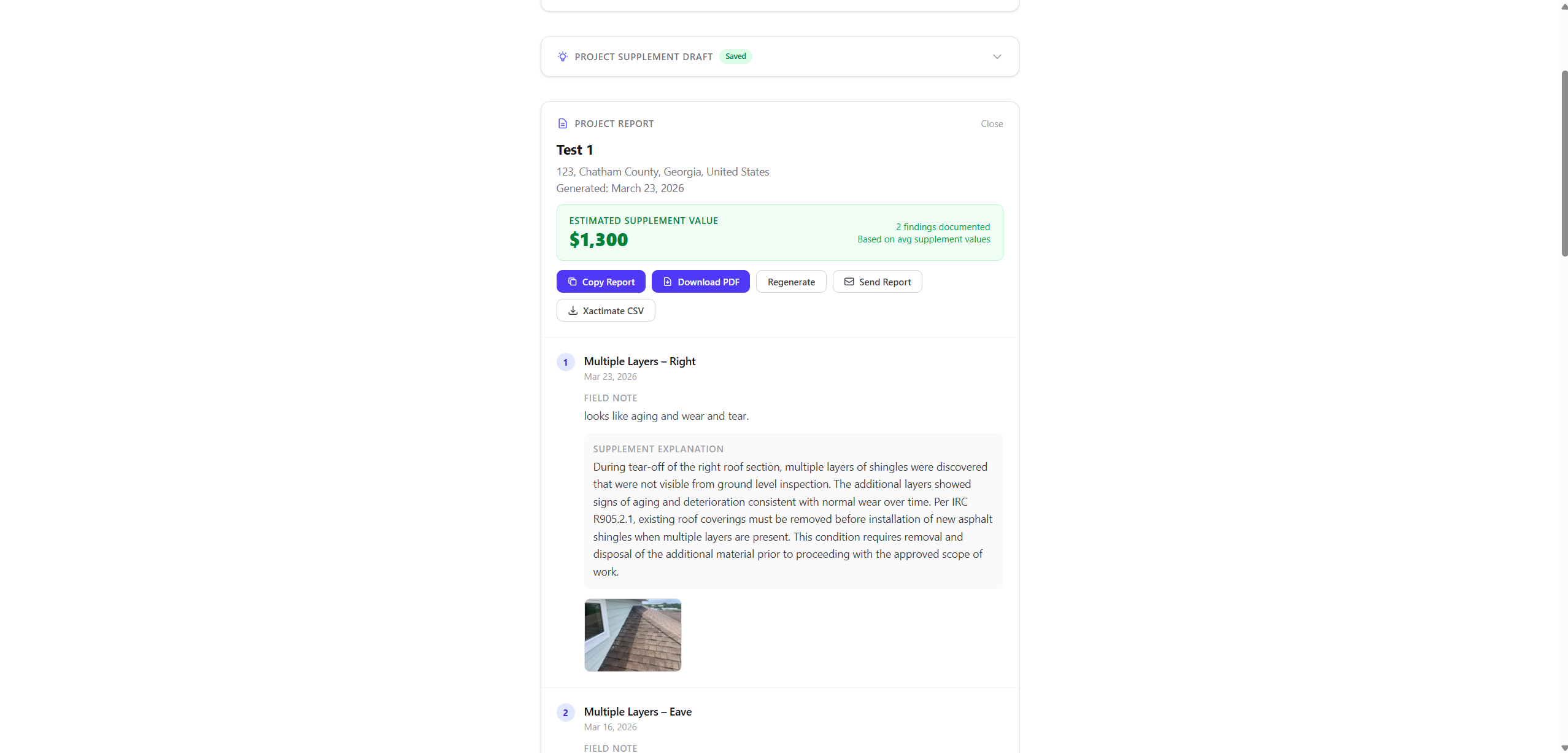
Supplement Snap automates this process. Your crew captures damage findings during tear-off: photos tagged by damage type, roof area selected, and a voice note describing what they found. Voice notes work in any language, so Spanish-speaking crews describe findings naturally and the system auto-translates to English.
From that field data, Supplement Snap automatically maps each finding to the correct Xactimate line codes with sub-items. A 'Decking' finding generates RFG SHTHN with the measured square footage. A 'Flashing' finding generates RFG FLSH with the linear footage. Each line item includes current unit pricing.
You can export the complete supplement as an Xactimate-compatible CSV that the adjuster can import directly into their system. You also get a professional PDF report with photos, AI-generated narratives, a findings summary, and the complete line item breakdown, ready to email to the adjuster the same day.
The result is a supplement that speaks the adjuster's language, includes the evidence they need, and arrives the same day the damage was found. That combination (correct format, strong documentation, fast submission) is what gets supplements approved.
Need the full code list? See our complete Xactimate codes reference.
References & Resources
Ready to streamline your supplement process?
Supplement Snap helps your crew capture hidden damage during tear-off and generate adjuster-ready reports in minutes.
Written by
Kelvin Spratt
Founder, Supplement Snap
Kelvin builds software for roofing contractors who are tired of leaving supplement money on the table. His background in software development and insurance restoration workflows drives everything Supplement Snap does.