How to Document Rotted Roof Decking Found During Tear-Off
Kelvin Spratt
Founder, Supplement Snap · October 23, 2026
Key Takeaways
What to photograph, measure and write down when you find rotted roof decking during tear-off, so the finding is clear to the adjuster.
Preparing a supplement? Use the free checklist so nothing is missing when you submit.
Why decking is the finding adjusters ask about most
Decking is hidden until the shingles and underlayment come off. That is exactly why it needs clear proof. The adjuster was not on the roof at tear-off, so your photos, measurements and notes are the only way they see what you saw.
The goal is not to argue for more money. It is to show, factually, what condition the decking was in, where it was, and how much of it was affected. Coverage and approval still depend on the claim, the policy and the carrier.
Free download
Roof tear-off findings log
A log for the roof: where each finding is, what it is, how much, and which photos show it, with a checklist before you leave.
Fillable PDF: open it in a PDF reader such as Adobe Acrobat Reader to type into the blanks. Some phone and browser previews cannot.
See all free roofing templates →
No email or sign-up needed. General guidance, not legal advice. Adjust it to your carrier's, client's and state's requirements.
What to record at the roof
Capture these items for every area of damaged decking:
Location: Which slope or roof area, described the same way in the photo label and the notes.
Condition: Soft, rotted, delaminated, water-stained, cracked or sagging, as you actually observed it.
Extent: Number of sheets or boards, or the approximate square feet affected.
Context: A wide shot showing where the area sits on the roof, then close-ups of the worst boards.
Scale: A tape measure or another known object in frame for size.
Take the photos before the decking is replaced or covered. Once new material goes down, the evidence is gone.
Capture this on the roof, not from memory.
Supplement Snap lets your crew take photos and voice notes at tear-off and drafts a report you review before sending. Your first project is free.
How to write the note
Keep it short and factual. A useful note answers four questions: what was found, where, how much, and why it was not visible before tear-off.
Example: Rear slope, along the eave: four sheets of decking soft and deteriorated when walked, found after removing existing shingles and underlayment. Photos 12 to 16 show the condition.
Avoid guessing at the cause or at what the policy covers. Describe what you can see and measure, and let the adjuster evaluate coverage.
Match photos, measurements and line items
Before you submit, check that the numbers agree. If the note says four sheets, the photos should show four sheets and the line item quantity should reflect that. Mismatches are the quickest way to lose trust with an adjuster.
If you want a full pre-submission check, use the free roofing supplement checklist. For layout help, see the roofing supplement template and the photo documentation checklist.
A copy-and-paste checklist for decking
Wide photo of the slope, showing where the damage sits
Close photo of each soft, rotted or delaminated area with a tape
Photo of a screwdriver or probe pressed into the wood
Photos of the old underlayment and shingles over it as they come off, if you can capture them
Sheets or square feet affected, written down with the arithmetic
The slope and where on it
A short factual note, with photo numbers
Our free findings log has a row for each.
Decking, sheathing, plywood and OSB
People use several words for the same layer. Decking and sheathing both mean the boards or panels the roofing is attached to. Plywood is thin layers of wood glued together. OSB, or oriented strand board, is made of pressed wood strands. Older homes may have plank boards instead. Use the word that matches what you see, and say which kind it is, because it affects how damage looks and how it is described.
Counting sheets and square feet
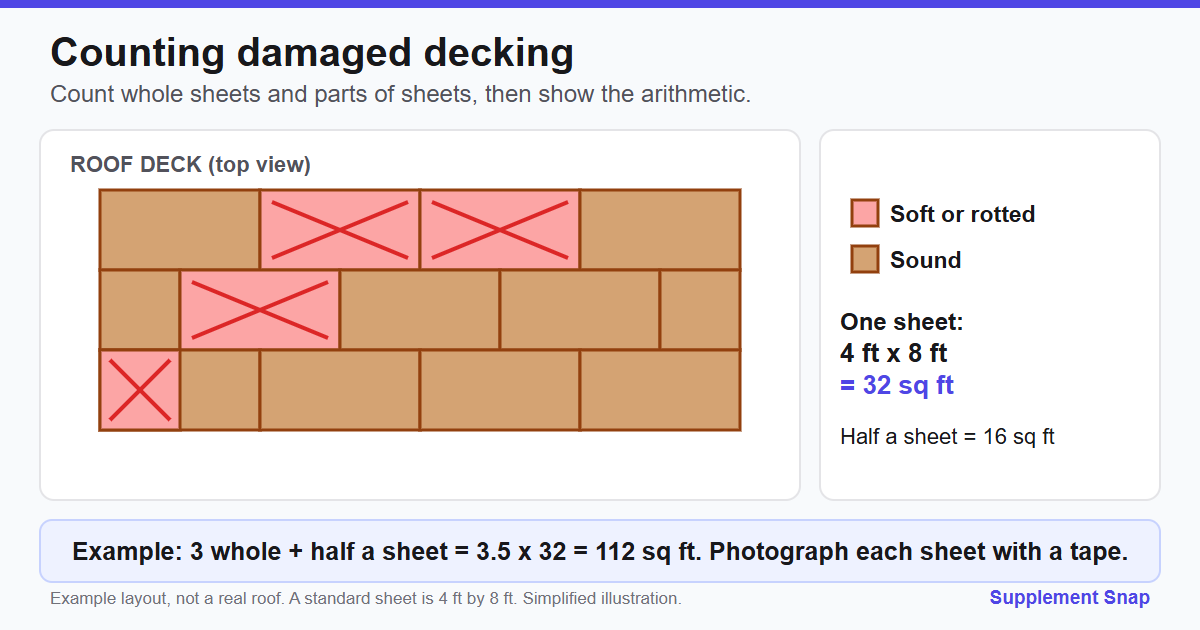
A standard sheet is 4 feet by 8 feet, which is 32 square feet. Four sheets are 128 square feet. If damage covers part of a sheet, say so rather than rounding up without explanation: about half of a sheet along the eave, roughly 16 square feet, for example. Show the arithmetic in your note, such as 4 ft x 8 ft x 4 sheets = 128 sq ft, so a reviewer can check it.
When the damage followed a storm
Reviewers often want to know whether rot was sudden or has been building for a long time. That is not for you to decide, and guessing weakens your package. What you can do is photograph the layers as they come off, show the condition of the underlayment and shingles above the soft area, and describe exactly what you see. Our guide to wind damage documentation covers the rest of that package. Building codes, policy wording and carrier practice vary, so confirm the details for your job.
Doing this faster on the roof
The slow part is usually not taking photos. It is matching them to notes and measurements later. Capturing the photo, the roof area and a short note at the same moment keeps everything linked.
That is the workflow Supplement Snap is built around: photograph, tag and describe the finding on the roof, then generate a report. You can preview the output in the sample report. Software organizes the evidence; it cannot guarantee a supplement is approved.
Frequently asked questions
How many photos of rotted decking should I take?
Take a wide shot showing where the damage sits on the roof, then close-ups of the worst boards with a scale in frame. Take enough that someone who was not there can see the condition and the extent.
Should I state why the decking rotted?
Stick to what you observed and measured. Speculating about cause can cause problems. Describe the condition and location and let the adjuster determine coverage.
Does documenting decking guarantee the carrier pays for it?
No. Clear documentation helps you present the finding, but payment depends on the claim, policy and carrier.
What is the difference between plywood and OSB decking?
Plywood is made of thin glued layers of wood. OSB is pressed wood strands. Both are used as decking, and they can fail differently when wet, so say which you found.
How do I count decking in square feet or sheets?
A standard sheet is 32 square feet. Count whole and partial sheets, write the arithmetic, and keep photo numbers beside the count.
Can damaged decking be repaired instead of replaced?
Sometimes small areas can be repaired. If you replaced it, write why: soft to the probe, delaminated, or unable to hold fasteners. The reviewer may reasonably ask.
Free tools and resources
Ready to streamline your supplement process?
Supplement Snap helps your crew capture hidden damage during tear-off and generate adjuster-ready reports in minutes.
Written by
Kelvin Spratt
Founder, Supplement Snap
Kelvin builds software for roofing contractors who are tired of leaving supplement money on the table. His background in software development and insurance restoration workflows drives everything Supplement Snap does.