Roof Damage Report Template: Sections, Example and Checklist
Kelvin Spratt
Founder, Supplement Snap · October 23, 2026 · Updated October 23, 2026
Key Takeaways
A copyable roof damage report template with the sections to include, a sample finding, a photo checklist and the mistakes that make reports hard to use.
Preparing a supplement? Use the free checklist so nothing is missing when you submit.
What a roof damage report is
A roof damage report is a written record of the conditions found on a roof, supported by photos and measurements. It is used by homeowners to understand a problem, by insurance adjusters to review a claim and by contractors to scope and price the work.
The best reports are short, specific and easy to verify. Someone who was not on the roof should be able to understand what you found, where it is and why it matters without calling you.
Below is a template you can copy, a sample finding and a checklist for the photos. It is general guidance. Add whatever your carrier, client or jurisdiction requires.
Free download
Roof damage report template
Job details, roof summary, numbered findings, recommendations, a photo index and a photo checklist.
Fillable PDF: open it in a PDF reader such as Adobe Acrobat Reader to type into the blanks. Some phone and browser previews cannot.
See all free roofing templates →
No email or sign-up needed. General guidance, not legal advice. Adjust it to your carrier's, client's and state's requirements.
The sections to include
A complete report follows a predictable order. Each section has a clear job, and together they let the reader move from the big picture to the details.
Keep the headings the same on every report. Consistency makes your reports faster to write and easier for others to read, and it helps you notice when something is missing.
Job and claim details
Address, date, inspector, carrier, claim number and date of loss if there is one.
Roof summary
Roof type, approximate age, number of layers, slopes and general condition.
Findings by roof area
Each finding with its location, description, measurement and photos.
Recommendations and scope
What work is proposed, stated plainly and tied to the findings.
Photo index and attachments
A numbered list of photos plus any measurement reports or documents.
Capture this on the roof, not from memory.
Supplement Snap lets your crew take photos and voice notes at tear-off and drafts a report you review before sending. Your first project is free.
Copyable template
Copy the structure below into a document or spreadsheet and fill it in for each job.
Job details: Property address. Date of inspection. Inspector name. Client name. Carrier, claim number and date of loss, if applicable.
Roof summary: Roof type and material. Approximate age if known. Number of layers. Number of slopes and pitch. General condition in one or two sentences.
Findings (repeat for each): Finding number. Roof area or slope. What was observed. Measurement or count. Photo numbers. Why it matters, stated factually.
Recommendations: Proposed repair or replacement scope, tied to the numbered findings.
Photo index: Each photo number with its roof area and a short description.
Attachments: Aerial or manual measurement report, estimate, invoices or other supporting documents.
Photo checklist
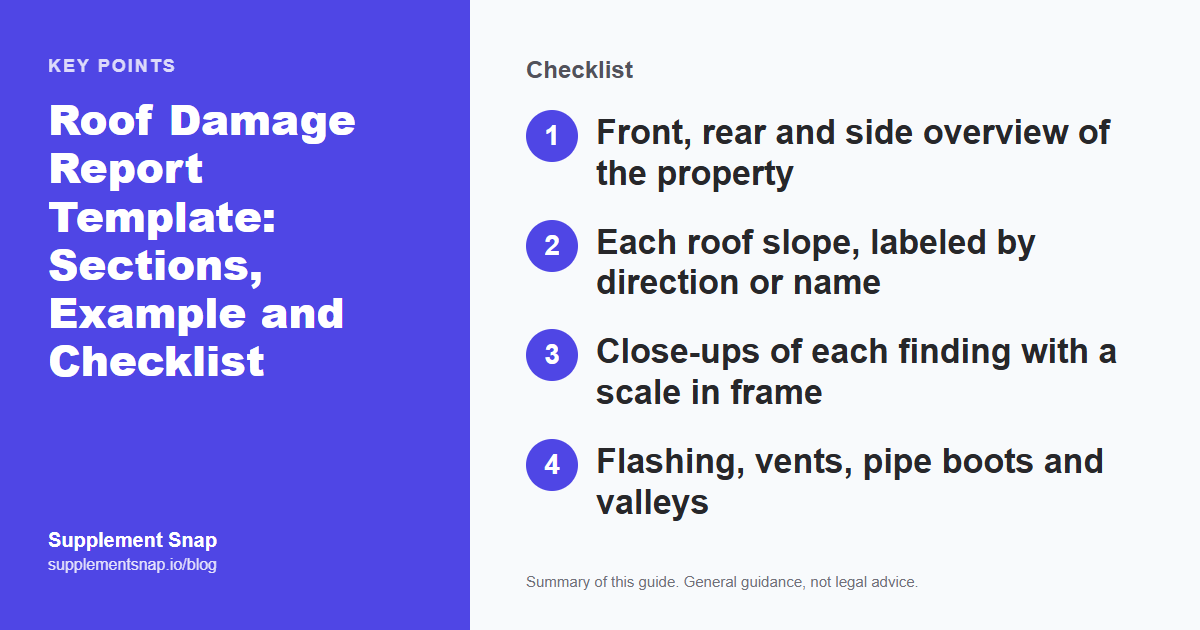
Photos carry most of the weight in a damage report. The checklist covers the shots that make a report clear. Take wide shots first, then close-ups, and keep your labels consistent.
For a deeper guide to what to photograph and when, read the roofing photo documentation checklist. For organizing the files afterward, see how to organize photos by claim and roof area.
Photo checklist for a damage report
A sample finding (fictional)
Here is one finding written in the style that works:
Finding 3. Rear slope, along the eave. Four sheets of roof decking were soft and deteriorated when walked, found after removing existing shingles and underlayment. Approximately 128 square feet affected. Photos 14 to 19. The condition was not visible from the surface before tear-off.
Notice the order: location, observation, quantity, photo reference and a factual note on why it was not seen earlier. It does not guess at the cause or argue about coverage. If you are documenting rotted decking specifically, see how to document rotted roof decking.
Write what you saw, not what you assume
A finding like 'three cracked shingles on the rear slope near the valley' is verifiable. A finding like 'storm damage throughout' is not. Specific beats sweeping every time.
Mistakes that make reports hard to use
These are the issues that most often make a report less useful:
No location: A finding that does not say where on the roof it is forces the reader to guess.
Photos without context: A close-up with no wide shot is hard to place.
No scale: Without a tape measure or known object, size is a guess.
Sweeping statements: Phrases like damage throughout invite doubt.
Mismatched numbers: Notes, photos and totals that disagree reduce trust in everything else.
Opinions presented as facts: Cause and coverage are for others to decide.
Before you send, run the finished report through the free supplement checklist.
Turning the template into a faster workflow
Writing this by hand works, but it takes time to match photos to notes and build a clean document each time. Supplement Snap follows the same structure: the crew captures photos, tags the roof area and adds a note on the roof, and the report is assembled for you to review. See the sample supplement report to compare it with the template above.
Software makes reports faster and more consistent. It does not guarantee that a claim is approved. Coverage and approval depend on the claim, the policy and the carrier.
How to write the recommendations section
The recommendations section answers one question: given these findings, what work do you propose? Keep it tied to the numbered findings so nothing floats free.
A clear recommendation names the work, the area and the finding it addresses. For example: Replace damaged decking, rear slope, 128 square feet (Finding 3). Replace failed step flashing at the sidewall, 24 linear feet (Finding 5).
Two habits keep this section trustworthy. First, do not recommend work you cannot point to a finding for. Second, separate what is clearly needed from what is optional, so the reader can see the difference.
Adapting the report for different readers
The same findings can be presented differently depending on who will read the report:
Homeowner: Use plain language, explain why each finding matters in a sentence and keep the photo selection tight.
Insurance adjuster: Lead with location, quantity and photo references. Keep the tone factual and avoid opinions about coverage.
Your office: Include everything needed to write an accurate estimate without calling the crew, including measurements and any access or safety notes.
You do not need three separate reports. Keep one set of findings, and change the summary and emphasis for each reader. If the report is for an insurance claim, the guide to how adjusters evaluate roof damage explains what they tend to look for.
Frequently asked questions
What should a roof damage report include?
Job and claim details, a roof summary, findings by roof area with measurements and photos, recommended scope, a photo index and any supporting documents.
How long should a roof damage report be?
As long as it needs to be to be clear. Short, specific findings with labeled photos are better than long general descriptions.
Do I need special software to write one?
No. A document or spreadsheet using a consistent template works. Software mainly saves time matching photos and notes and building the report.
Should I state the cause of the damage?
Stick to what you observed and measured. Cause and coverage are decided by others, and speculation can hurt your credibility.
Will a good report guarantee an insurance claim is approved?
No. A clear report helps the reviewer verify what you found, but approval depends on the claim, the policy and the carrier.
References & Resources
Free tools and resources
Ready to streamline your supplement process?
Supplement Snap helps your crew capture hidden damage during tear-off and generate adjuster-ready reports in minutes.
Written by
Kelvin Spratt
Founder, Supplement Snap
Kelvin builds software for roofing contractors who are tired of leaving supplement money on the table. His background in software development and insurance restoration workflows drives everything Supplement Snap does.