How Insurance Adjusters Determine Roof Damage (and What Documentation Helps)
Kelvin Spratt
Founder, Supplement Snap · October 23, 2026 · Updated October 24, 2026
Key Takeaways
How insurance adjusters evaluate roof damage: the inspection, what they look for, how estimates are built and what documentation makes a claim easier to review.
Preparing a supplement? Use the free checklist so nothing is missing when you submit.
The short answer
Insurance adjusters determine roof damage by inspecting the roof, identifying damage that matches the reported cause of loss, measuring it, and then pricing the repair using line items and regional prices. The result is then adjusted for the policy: the deductible, depreciation and any coverage limits.
In practice, the adjuster is answering three questions. Is there damage? Was it caused by a covered event? What does it cost to repair or replace? Everything you document should help answer one of those questions clearly.
This guide explains how the process generally works and what contractors can do to make a claim easier to review. It is general information, not legal or insurance advice, and details differ by carrier, policy and state.
Free download
Roof damage report template
Job details, roof summary, numbered findings, recommendations, a photo index and a photo checklist.
Fillable PDF: open it in a PDF reader such as Adobe Acrobat Reader to type into the blanks. Some phone and browser previews cannot.
See all free roofing templates →
No email or sign-up needed. General guidance, not legal advice. Adjust it to your carrier's, client's and state's requirements.
How the adjuster's evaluation usually runs
The sequence below is typical, though carriers differ and some steps may be done remotely. The adjuster does not decide in the driveway. They gather evidence, build an estimate and then apply the policy.
A contractor's role is to supply accurate, well-organized information alongside that process, not to replace the adjuster's judgment. The more clearly your findings are presented, the faster the review tends to go.
Review the claim and policy
The adjuster checks the date of loss, the reported cause and what the policy covers.
Inspect the roof and property
On the roof when safe, or with drone or aerial imagery. Photos and measurements are taken.
Identify and measure damage
Damage is tied to the covered cause of loss and recorded by slope and component.
Build the estimate
Line items, quantities and regional pricing are written up, often in estimating software.
Apply policy terms and issue a decision
Deductible, depreciation and coverage limits are applied and the carrier communicates the result.
What adjusters look for on the roof
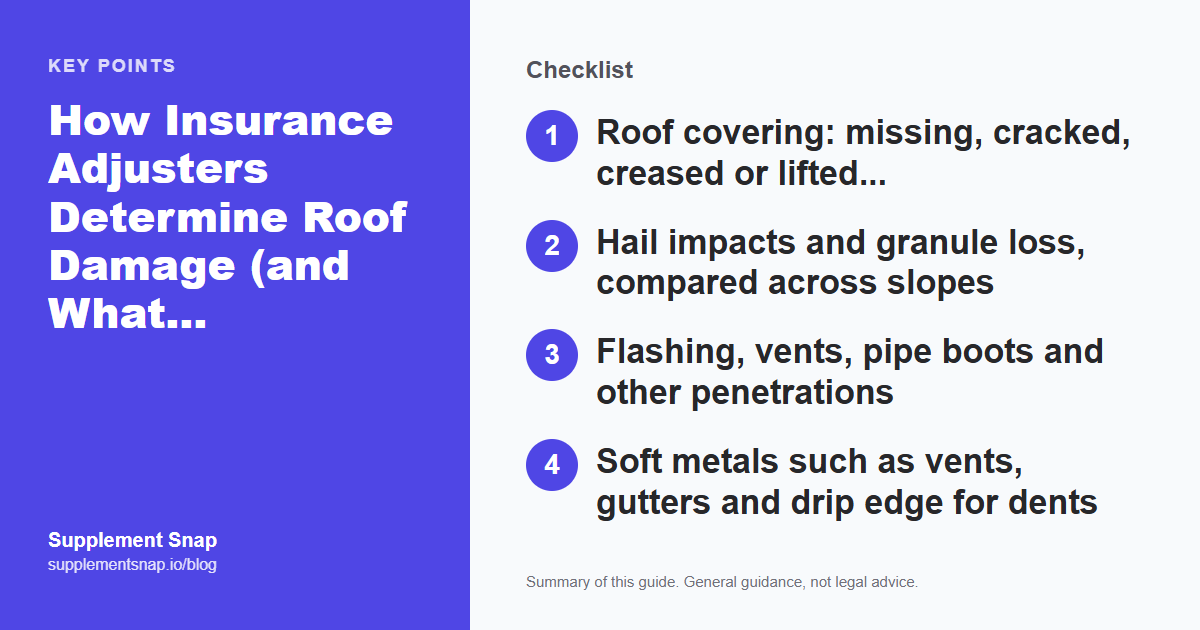
The specific signs depend on the cause of loss. For wind, adjusters look for missing, creased or lifted shingles. For hail, they look for impact marks and granule loss and compare slopes. Across all claims they check penetrations and flashing, and they note the age and general condition of the roofing system.
Two concepts come up often:
Test squares: In hail claims, some carriers evaluate a representative section of each slope and count impacts within it. The threshold for what counts as functional damage varies by carrier and guideline.
Collateral damage: Dents in soft metals, such as vents, gutters and flashing, can help show that a hail event reached the property.
The adjuster also separates storm damage from wear and age. That distinction is one of the most common sources of disagreement, which is why clear photos and honest descriptions matter.
What adjusters commonly look at on a roof
How the estimate is built
After the inspection, the adjuster turns findings into an estimate made of line items. Each line has a description, a quantity, a unit and a price from a regional price list, usually built in estimating software such as Xactimate.
The estimate then goes through the policy:
Deductible: The amount the policyholder pays first.
Depreciation: Some policies pay actual cash value first, which accounts for the age and condition of materials, and release more after the work is done. Others pay replacement cost. It depends on the policy.
Limits and exclusions: Coverage may be limited for certain causes or components.
If you want to see what these line items look like, read the Xactimate roofing estimate example and the Xactimate roofing supplement list.
Rules vary by carrier and policy
Inspection methods, hail thresholds and how depreciation is applied differ between insurers and policies. Use this guide for the general picture and confirm specifics with the claim documents.
Why the first estimate is often incomplete
The first estimate is based on what can be seen from the surface and in imagery. Decking, underlayment and flashing conditions beneath the shingles are not visible until tear-off. That is why supplements exist: they request additional costs for conditions found once the work begins.
This is normal and not a sign that anyone acted improperly. It does mean the contractor needs proof, because the adjuster was not on the roof when the old materials came off. For the basics, read what a supplemental roofing estimate is.
What documentation makes review easier
Adjusters work through many claims. A package that is easy to verify gets reviewed faster and generates fewer follow-up questions. These habits help:
Wide and close-up photos: Show where the damage is on the roof, then the condition itself.
Labels: Roof area and what the photo shows, so nothing is ambiguous.
Measurements: A scale in frame and quantities that match your notes.
Factual notes: What was observed, where and how much, without guessing at coverage.
Timing: Photos taken before concealed conditions are covered again.
Organization: Findings grouped by roof area, with photos beside each one.
The free roofing supplement checklist covers all of this in a printable form, and the photo documentation checklist goes deeper on what to photograph.
What to avoid when working with an adjuster
These approaches tend to slow claims or erode trust:
Overstating damage: Describing normal wear as storm damage invites a hard look at everything else you submit.
Guessing at cause or coverage: Stick to what you can see and measure. Coverage decisions belong to the carrier.
Missing proof: A line item with no photo or measurement gives the adjuster nothing to verify.
Slow responses: When a carrier asks for more information, answer promptly and keep a record.
Tracking each request helps. See the roofing supplement follow-up log for a simple way to do it.
Should the roofer be there for the adjuster's inspection?
Many contractors attend the inspection when the homeowner asks them to, because they can point out damage and answer questions about the roof. Whether and how that works is up to the homeowner, the policy and the carrier, so ask the adjuster in advance.
Two cautions. First, rules differ by state, and some restrict what a contractor may do on a homeowner's behalf, such as negotiating or advocating for the claim, because that can fall under public adjuster licensing. Check what is allowed where you work. Second, stick to facts you can show: what you saw, where it is, and photos. Do not guess at cause or promise the homeowner an outcome.
This is general guidance, not legal advice.
How Supplement Snap helps contractors present findings
Supplement Snap helps crews capture photos, roof areas, notes and measurements while they are on the roof, and organizes them into a report for the adjuster. It does not decide coverage or guarantee approval. It gives the adjuster a clearer package to review. You can preview the output in the sample report.
Frequently asked questions
How do insurance adjusters determine roof damage?
They inspect the roof, identify damage consistent with the reported cause of loss, measure it and price the repair with line items. The policy terms, such as deductible and depreciation, are then applied.
What is a test square in a roof inspection?
A test square is a representative section of a roof slope used in some hail evaluations. Impacts within it are counted, and each carrier uses its own thresholds.
Can an adjuster inspect a roof without going on it?
Sometimes. Some carriers use drone or aerial imagery, depending on the roof, the claim and company guidelines.
Why does the adjuster's estimate sometimes miss damage?
Conditions under the shingles, such as damaged decking or flashing, cannot be seen until tear-off. Contractors request those items through a supplement with supporting documentation.
Should a roofer be present with an insurance adjuster?
Many contractors attend when the homeowner asks them to, to point out damage and answer roof questions. Rules vary by state, and some limit what a contractor may do for the homeowner on the claim, so check what is allowed where you work.
Does good documentation guarantee a claim is approved?
No. Coverage and approval depend on the claim, the policy and the carrier. Good documentation helps the adjuster verify what was found.
References & Resources
Free tools and resources
Ready to streamline your supplement process?
Supplement Snap helps your crew capture hidden damage during tear-off and generate adjuster-ready reports in minutes.
Written by
Kelvin Spratt
Founder, Supplement Snap
Kelvin builds software for roofing contractors who are tired of leaving supplement money on the table. His background in software development and insurance restoration workflows drives everything Supplement Snap does.
More Articles
Meeting the Insurance Adjuster on the Roof: What to Bring and Do
Read more →
How to Request a Reinspection on a Roof Claim (and When a Supplement Fits Better)
Read more →
What Is a Supplemental Roofing Estimate? When It Applies and What It Includes
Read more →
Hail Damage Roof Inspection: What Gets Missed and How to Document It
Read more →