Deck Damage From Old Underlayment and Rusted Nails: Document It
Kelvin Spratt
Founder, Supplement Snap · October 25, 2026 · Updated October 26, 2026
Key Takeaways
When old self-adhered underlayment tears the deck or rusted nails lose their grip, the evidence ends up in the dumpster. How to photograph it first.
Preparing a supplement? Use the free checklist so nothing is missing when you submit.
The short answer
Two conditions show up only once the old roof is off: old self-adhered underlayment that bonds so tightly the deck surface tears when it is removed, and rusted or loosened fasteners that no longer hold. Both can mean the deck needs partial replacement before new roofing is installed. Because the evidence is destroyed when the sheets go in the trailer, the crew has to photograph it on the roof: close shots, a tape, the slope, and a count of sheets. The carrier decides what to pay.
Disclosure: we make Supplement Snap, which helps roofing crews document damage found at tear-off and export a report. It does not decide coverage, negotiate claims or guarantee approval. This page is general guidance, not legal or claims advice.
Free download
Roof tear-off findings log
A log for the roof: where each finding is, what it is, how much, and which photos show it, with a checklist before you leave.
Fillable PDF: open it in a PDF reader such as Adobe Acrobat Reader to type into the blanks. Some phone and browser previews cannot.
See all free roofing templates →
No email or sign-up needed. General guidance, not legal advice. Adjust it to your carrier's, client's and state's requirements.
Why the evidence disappears
Torn or delaminated decking is thrown away with the old roof. Rusted nails come off with the shingles. A reviewer who was not on the roof cannot judge what they cannot see, so a description with no photo carries little weight. The table lists what to capture before the material is removed.
| Feature | What to capture |
|---|---|
| The underlayment | Close photo of old self-adhered underlayment bonded to the deck and what happens as it is lifted |
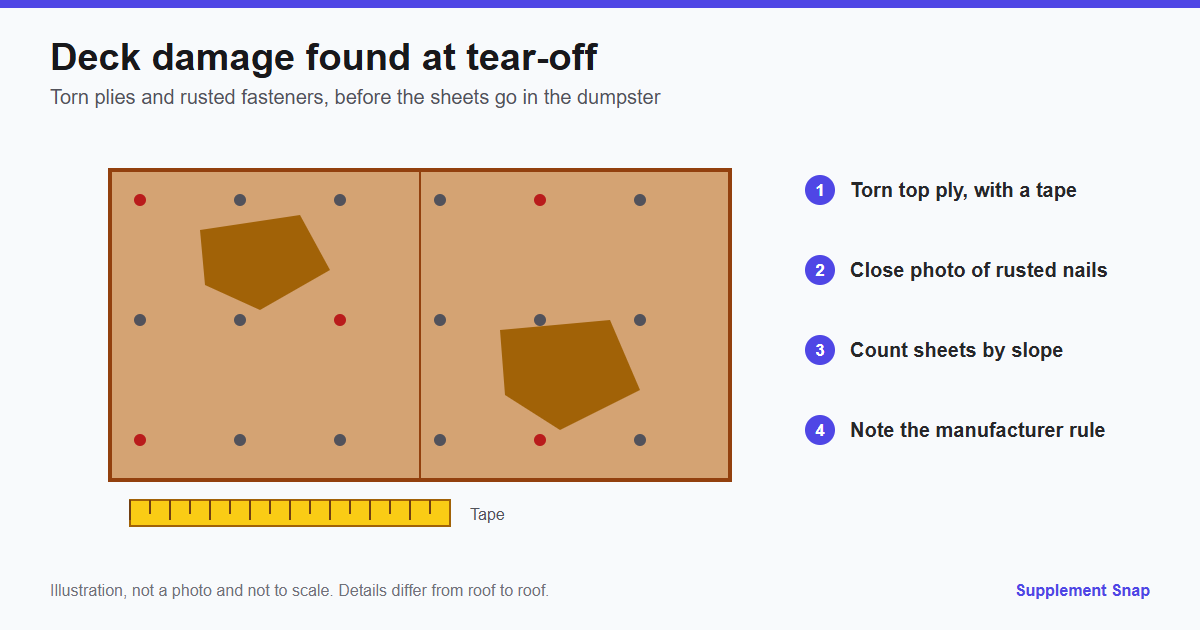
| The deck surface | Top ply torn, shredded or delaminated, with a tape for size |
| The fasteners | Close photos of rusted or pulled-through nails, and nail heads that no longer hold |
| The area | Which slope, and how many sheets or square feet are affected |
| The test | A photo of how the deck holds a new fastener, or fails to |
Capture it before the sheets hit the dumpster.
Supplement Snap lets your crew log each finding by slope with photos and notes at tear-off. Your first project is free.
Step 1: Photograph the underlayment as it comes up
Take a close photo of the old underlayment bonded to the deck, then another as the crew lifts it showing what comes with it. If the top ply of the plywood or the surface of the OSB tears away, photograph the torn area with a tape. Do it for each slope where it happens, not just one.
Step 2: Photograph the fasteners
Pull a few shingles back or lift a section of deck and photograph the nail shanks and heads close up. Rusted shanks, nails that have pulled through the deck, and heads that spin freely are all worth a clear shot with a tape. Note which slope and where on it. Our decking documentation guide covers the sheet-by-sheet count.
Describe what the deck does, not what you assume
Say the top ply tears away when the underlayment is removed, or that the nails pull through. Check the shingle maker's deck requirements and your local code before saying the deck does not meet them.
Step 3: Count the area
Write how many sheets or how many square feet on each slope are affected. If you walk the deck and it flexes, or fasteners will not bite, note it as an observation. Do not write that the whole roof is bad unless you have checked every slope.
Step 4: Say what is required, with sources
If you are saying the deck must be replaced to install the new roof, point to something you can show: the shingle manufacturer's deck and fastening requirements, the underlayment maker's instructions, or the building department's requirement. Attach the page, or ask the building department for it in writing. Building codes, manufacturer instructions, policy wording and carrier practice vary, so confirm the details for your job with the building department and the claim documents.
A worked example (fictional)
On a steep rear slope, the crew peels back an old self-adhered underlayment. The top ply of the plywood comes up with it in strips. The lead photographs the bonded underlayment, the torn deck with a tape, and a handful of rusted nails with the heads pulling through. He counts nine sheets affected, writes it by slope, and sends the log.
The office builds one finding for the sheets, one for the rusted fasteners, attaches the manufacturer's deck requirements and asks for review. The example is invented. The carrier may decide differently, and some tears can be repaired without replacing the sheet.
How to word the request
Decking, rear slope: 9 sheets with the top ply torn away when old self-adhered underlayment was removed, photos 33 to 38 with a tape. Rusted fasteners pulling through the deck on the same slope, photos 39 to 41. Replacement of affected sheets requested. Manufacturer deck requirements attached.
Keep the torn sheets and the fastener condition as separate findings.
A copy-and-paste checklist
Close photo of the old underlayment bonded to the deck, with a tape
Photo of what comes up when it is lifted
Photo of torn, shredded or delaminated deck surface with a tape
Close photos of rusted or pulled-through nail shanks and heads
The slope, and sheets or square feet affected
A photo of how a new fastener holds, if the crew tested it
The manufacturer's deck and fastening page you rely on
Where to look for the requirement
Roofing materials come with installation instructions that usually say what the deck must be, how fasteners must hold, and how to prepare it. Local code may add its own rules. Find the instructions for the shingle and underlayment you are installing, copy the relevant page, and ask the building department in writing if you rely on a code rule. Quote only what you can show. Building codes, manufacturer instructions, policy wording and carrier practice vary, so confirm the details for your job with the building department and the claim documents.
Repair or replace
Not every torn spot needs a new sheet. A reviewer may reasonably ask why a section was replaced instead of repaired. Write what you saw and why: for example, the top ply came away over a large area, fasteners would not hold, or the deck flexed underfoot. If you repaired a small area instead of replacing a sheet, say that too. Honest scope builds credibility.
What is delamination
Plywood is made of thin layers glued together. Delamination is when those layers separate, often after moisture or when something bonded to the surface is pulled off. Photograph it with a tape and describe it in plain words: top layer peeled away over about two feet by three feet, for example. Avoid technical terms you cannot back up.
Mistakes to avoid
Photographing only the new, clean deck
Claiming the whole roof deck is failed without checking each slope
No tape or scale in the photo
Stating a code or manufacturer requirement you did not check
Throwing the sheets away before photographing them
Frequently asked questions
Does insurance pay for decking damaged when removing old underlayment?
It depends on the policy, the cause and the carrier's review. Document the condition and ask. Do not promise the homeowner it will be covered.
How do I prove rusted nails matter?
Photograph the nail shanks and heads close up with a tape, and note where the nails pull through. Then point to the manufacturer's or code requirement for fastening.
Can torn decking be repaired instead of replaced?
Sometimes. The reviewer may ask. Describe what you saw and why you chose to replace it.
Do I count by sheet or square foot?
Either, as long as you show the arithmetic. A sheet is typically 4 ft by 8 ft, 32 square feet.
Should I photograph every slope?
Yes where the condition appears. A photo on one slope does not prove the same on another.
Where do I find the manufacturer's requirements?
In the shingle and underlayment installation instructions, usually on the maker's website or the package. Attach the page you rely on.
Can you nail new roofing to rusted or damaged decking?
Shingle makers specify how fasteners must be driven and into what. If the deck cannot hold a fastener properly, the manufacturer's instructions and local code decide what is required. Check them before you describe the requirement to a reviewer.
What is peel-and-stick underlayment?
A self-adhering waterproof membrane that bonds to the deck. When it is old and well bonded, removing it can pull up the deck surface. Photograph that as it happens.
How much deck replacement is normal on a re-roof?
There is no reliable normal. It varies with the roof, its age and the conditions found. Count and photograph what you find on each slope.
References & Resources
Free tools and resources
Ready to streamline your supplement process?
Supplement Snap helps your crew capture hidden damage during tear-off and generate adjuster-ready reports in minutes.
Written by
Kelvin Spratt
Founder, Supplement Snap
Kelvin builds software for roofing contractors who are tired of leaving supplement money on the table. His background in software development and insurance restoration workflows drives everything Supplement Snap does.