Roofing Estimate Template: Free PDF, Word and Excel Download
Kelvin Spratt
Founder, Supplement Snap · October 24, 2026 · Updated October 24, 2026
Key Takeaways
Free roofing estimate template as PDF, Word and Excel, plus what every estimate should include and how it differs from an insurance supplement.
Preparing a supplement? Use the free checklist so nothing is missing when you submit.
The short answer
A roofing estimate needs seven things: your company details, the customer and property, a clear scope of work, materials, labor and other charges, a total price with an expiry date, and terms with a place for the customer to sign. The layout below puts them in that order, with blanks you can fill in, and you can download it as a PDF, fillable PDF, Word or Excel file just under this section. For a smaller job or a choice of options, see the roof repair estimate template and the good, better, best proposal template.
Disclosure: we make Supplement Snap, which is not an estimating tool. It helps crews document hidden damage after tear-off. This page is about the estimate you give a customer before work starts. If you are writing an insurance supplement instead, see our supplement template.
Free download
Roofing estimate template
Company details, scope of work, line items, other charges, terms and a signature line. Totals calculate in the Excel version.
Fillable PDF: open it in a PDF reader such as Adobe Acrobat Reader to type into the blanks. Some phone and browser previews cannot.
See all free roofing templates →
No email or sign-up needed. General guidance, not legal advice. Adjust it to your carrier's, client's and state's requirements.
What every roofing estimate should include
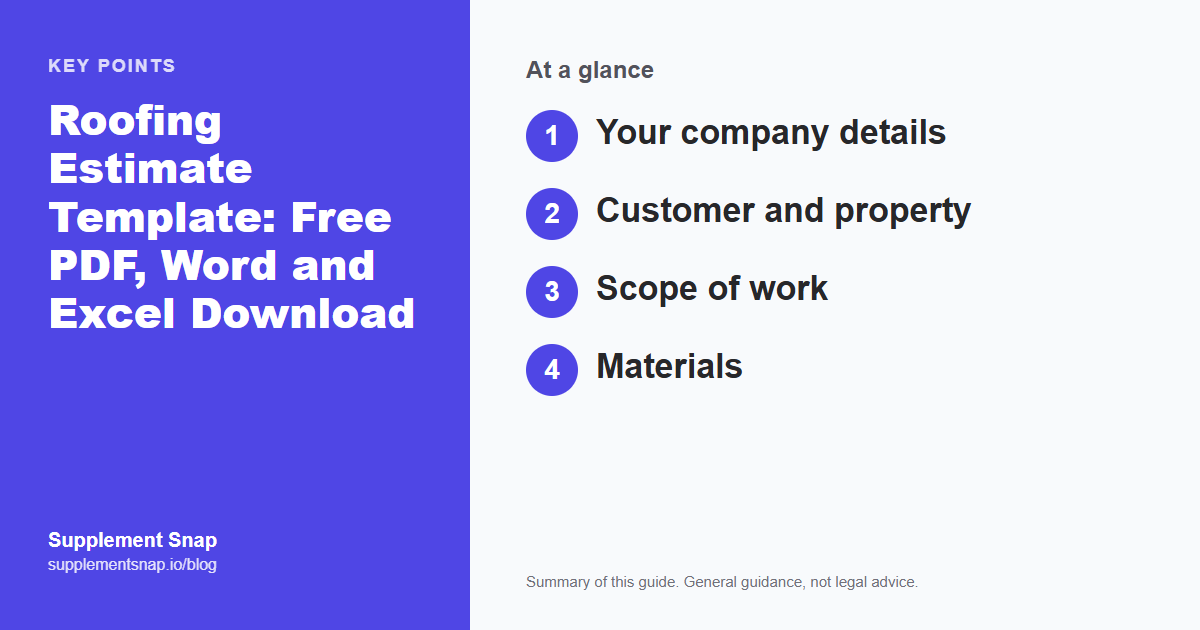
The table lists each section and why it is there. A customer who can follow the estimate is less likely to dispute it later, and you are less likely to be asked to do work you did not price.
Keep the language plain. If a customer cannot tell what is included, they will assume everything is.
| Feature | What to put in it | Why it matters |
|---|---|---|
| Your company details | Name, address, phone, email and license number if your state requires one | The customer knows who is responsible, and it keeps you compliant |
| Customer and property | Name, job address, contact details, date and an estimate number | You can find and refer to the estimate later |
| Scope of work | What you will tear off, repair or replace, area by area | Prevents arguments about what was included |
| Materials | Product, color, quantity and unit for each item | Shows what the price covers |
| Labor and other charges | Labor, disposal, permits, delivery or other fees, listed separately | Makes the total easy to follow |
| Price and how long it is good for | Total, the date it expires and what could change it | Protects you if material costs move |
| Terms and signature | Payment terms, warranty terms, and a line for the customer to accept | Turns an estimate into an agreement |
Found hidden damage after tear-off?
An estimate covers the work you can see before you start. Supplement Snap helps your crew document what turns up once the shingles are off. Your first project is free.
A layout to copy
Copy this into a document or spreadsheet and replace the blanks. The numbers are placeholders, not prices, so fill in your own.
Header: [Company name] [Address] [Phone] [Email] [License number if required]
Estimate: No. [____] Date: [____] Valid until: [____]
Customer: [Name] [Job address] [Phone] [Email]
Scope of work: Tear off [existing layers] on [roof areas]. Install [underlayment]. Install [shingle brand and color]. Replace [flashing, vents, drip edge as needed]. Clean up and haul away debris.
Line items: [Description] [Quantity] [Unit] [Unit price] [Amount]
Other charges: [Disposal] [Permit] [Delivery] [Other]
Total: [$____]
What could change the price: [for example, hidden decking damage found after tear-off, charged at the agreed unit price]
Terms: [Payment schedule] [Warranty terms] [Start date window]
Acceptance: Customer signature [____] Date [____]
Writing in the line about hidden damage matters. Tear-off often reveals rotted decking or extra layers, and an estimate that says how those will be handled avoids an awkward conversation later.
Retail estimates and insurance supplements are different documents
A retail estimate is written before the job and goes to the property owner. An insurance supplement is written after tear-off and goes to the adjuster, asking for money the carrier's estimate left out. The table shows the main differences.
If the owner is paying through an insurance claim, the carrier's estimate sets the starting scope. Your own estimate and the carrier's can differ, and the difference is where supplements come from. Our guides on how an Xactimate estimate looks and how to write one adjusters approve cover the insurance format.
| Feature | Retail estimate | Insurance supplement |
|---|---|---|
| Who it goes to | The property owner paying you directly | The insurance adjuster |
| What it covers | The planned work, priced before you start | Damage found after tear-off that was not in the carrier's estimate |
| What backs it up | Your measurements and your price list | Photos, measurements and notes tied to each finding |
| Format | Your own layout | Often follows the carrier's line-item format |
Mistakes that cause disputes
A vague scope. Write what is included roof area by roof area.
Lumping everything into one price. Separate materials, labor and extra charges so the customer can follow it.
No expiry date. Material prices change, and an estimate with no end date can be held against you for months.
Nothing about hidden damage. Say how rotted decking or extra layers will be handled.
No signature line. An unsigned estimate is a suggestion.
Promising an insurance outcome. Never tell a customer that the carrier will pay, because that depends on the policy, the claim and the carrier.
Check your local rules before you use it
Many states require specific language in home improvement contracts, a license number, a right-to-cancel notice, or limits on deposits. Some require a written contract above a certain amount. This template does not include state-specific wording.
Ask your state licensing board, your insurance agent or an attorney what must appear in your estimates and contracts. Do not rely on a template alone.
Rules differ by state
Licensing, written-contract requirements, cancellation rights and permitted payment terms vary by state and sometimes by city. This template is a starting layout, not legal advice. Have it reviewed against your local rules before you use it with customers.
Where Supplement Snap fits, and where it does not
Supplement Snap does not write retail estimates, measure roofs or send invoices. It is for the step after tear-off, when your crew finds damage that was not in the estimate. They photograph it on the roof, tag the damage type and roof area, add a typed or voice note, and the app drafts a written description of each finding for you to review and edit. You then export a PDF and email it to the adjuster.
Your first project is free. See the feature walkthrough, a sample report and the pricing page.
Frequently asked questions
What should a roofing estimate include?
Your company details, the customer and property, a clear scope of work, materials, labor and other charges, a total with an expiry date, and terms with a signature line. Add a note on how hidden damage will be handled.
Is there a free roofing estimate template?
The layout on this page is free to copy and has blanks for your own prices. Many invoicing tools also publish free roofing estimate templates in PDF, Word and Excel. Check any template against your state's requirements.
What is the difference between a roofing estimate and a quote?
Usage varies. An estimate is generally an approximate price and a quote a firm one, but some contractors use the words interchangeably. State on the document whether the price is fixed and how long it is valid.
How is a roofing estimate different from an insurance supplement?
An estimate is priced before the job and goes to the property owner. A supplement is prepared after tear-off and goes to the adjuster to request money for damage the carrier's estimate did not include.
Does a roofing estimate need a signature?
A signature line is good practice because it turns the estimate into an agreement. Some states have specific contract requirements, so confirm what yours requires.
References & Resources
Free tools and resources
Ready to streamline your supplement process?
Supplement Snap helps your crew capture hidden damage during tear-off and generate adjuster-ready reports in minutes.
Written by
Kelvin Spratt
Founder, Supplement Snap
Kelvin builds software for roofing contractors who are tired of leaving supplement money on the table. His background in software development and insurance restoration workflows drives everything Supplement Snap does.