Starter Strip and Ridge Cap on a Roof Claim: What to Check
Kelvin Spratt
Founder, Supplement Snap · October 25, 2026 · Updated October 25, 2026
Key Takeaways
Starter strip and ridge cap quantities are easy to undercount in an estimate. How to measure them, compare to the carrier's numbers, and document the gap.
Preparing a supplement? Use the free checklist so nothing is missing when you submit.
The short answer
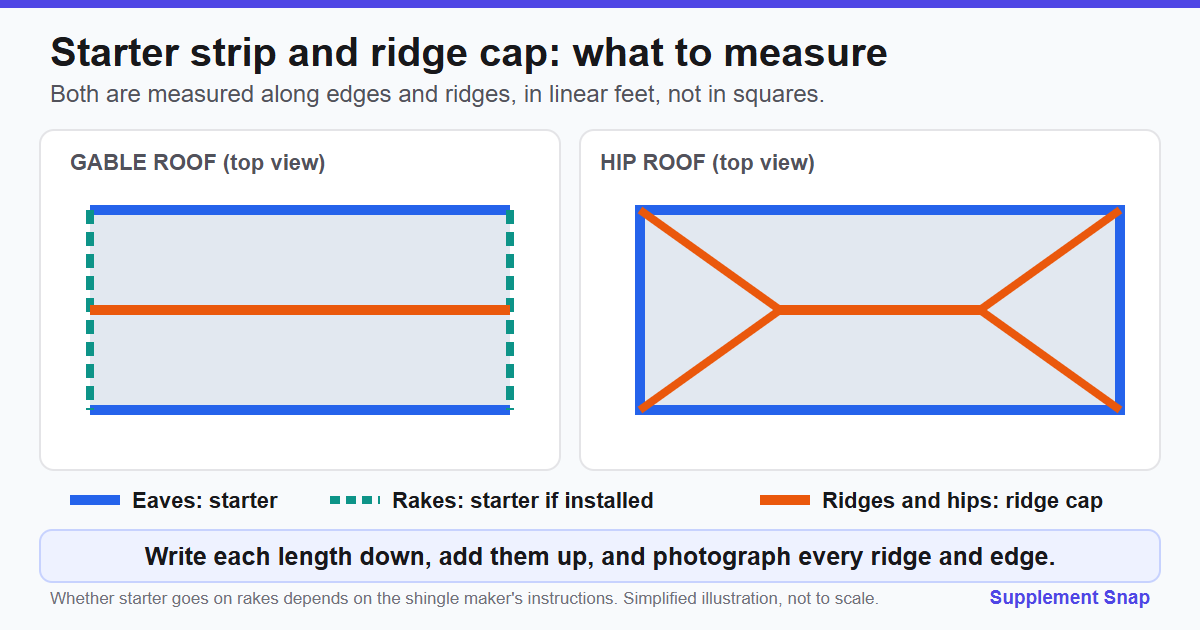
Starter strip is the first course along the edge of the roof. Ridge cap covers the ridges and hips. Both are measured in linear feet, not square feet, and both are easy to undercount if the estimate relies on roof area. A contractor can compare their own linear measurements to the estimate and document any gap.
Disclosure: we make Supplement Snap, which helps roofing crews document damage found at tear-off and export a report. It does not decide coverage, negotiate claims or guarantee approval. This page is general guidance, not legal or claims advice.
Free download
Roof tear-off findings log
A log for the roof: where each finding is, what it is, how much, and which photos show it, with a checklist before you leave.
Fillable PDF: open it in a PDF reader such as Adobe Acrobat Reader to type into the blanks. Some phone and browser previews cannot.
See all free roofing templates →
No email or sign-up needed. General guidance, not legal advice. Adjust it to your carrier's, client's and state's requirements.
Why they are easy to miss
Area-based measurements do not show ridge and edge lengths directly. Reports built from aerial images can be off on a complicated roof. The table covers what to measure so the numbers come from the roof, not a guess.
| Feature | How to measure |
|---|---|
| Starter strip | Linear feet along the eaves and, where installed, the rakes |
| Ridge cap | Linear feet of ridges and hips |
| Waste | The carrier's waste allowance may not match the product; note how you cut it |
| Product | Whether you use a standard or a specialty product, as the unit changes |
Count the edges and ridges once, with photos.
Supplement Snap helps your crew record linear footage and photos in one project. Your first project is free.
How to measure
For starter, add the eave lengths and the rake lengths if you install starter there. For ridge cap, add the ridge and hip lengths. Write each length and the sum. Walk the roof or use a reliable tool, and note which.
How to document
Photograph each ridge and hip, showing its full length where you can. Photograph the eaves. Number the photos and tie them to the measurements in your list.
Compare, don't assume
Some estimates include starter and ridge in the shingle line, others list them separately. Read the estimate before you call something missing.
Compare to the estimate
Find the starter and ridge lines in the carrier's estimate and note the quantities and units. If they differ from yours, write the two numbers side by side with your measurements. Do not assume the difference is an error. It might be a different product or waste factor.
How to word the request
Example: Ridge cap, 118 linear feet measured on roof, estimate shows 96. Photos 22 to 27. Starter, 168 linear feet, estimate shows 140. Photos 3 to 9.
Ask for the difference, show the work, and let the adjuster respond to each line.
A worked example (fictional numbers)
A gable roof has two eaves of 40 feet and two rakes of 28 feet, with one ridge of 40 feet. The contractor installs starter along the eaves and rakes, so the starter quantity is 40 + 40 + 28 + 28 = 136 linear feet. Ridge cap is 40 linear feet.
The carrier's estimate lists 80 linear feet of starter and 30 linear feet of ridge. The request lists each difference as its own finding: starter, 136 measured against 80 in the estimate; ridge, 40 measured against 30. The photos show the full run of each edge and the ridge, with a tape reading at one end. Those numbers are illustrative, not typical.
Waste and product choice
Starter and ridge cap products come in bundles with set coverage. Some contractors use a dedicated starter product and others cut shingles to make starter, which changes the amount of material needed. Write down what you actually use. If the carrier's estimate assumes a different method, name the difference without arguing it.
Hips and valleys
Hips take ridge cap, and some valleys take different material depending on the style. Count hips with the ridge when the same product is used, and write the lengths separately so the arithmetic is visible: Ridge 40 ft, Hip A 22 ft, Hip B 22 ft, total 84 ft.
Check the product line in the estimate
Estimates may name specific products or generic items. Read the line description. A line that says starter course or ridge cap is not the same as one that says shingle waste only. If the estimate's description does not match what is being installed, quote it back in your note so the reviewer can see what you compared.
Frequently asked questions
How is ridge cap measured?
In linear feet along the ridges and hips.
How is starter measured?
In linear feet along the eaves, and along the rakes where starter is installed.
Why do estimates differ from my measurements?
Aerial measurements, waste factors and product choices can all differ. Compare the numbers and note the difference.
Are starter and ridge ever included in the shingle line?
Some estimates combine them. Read the estimate before concluding something is missing.
Do I need photos of ridges?
Yes. They show length, condition and where the measurement came from.
Is starter strip measured in squares?
Starter is usually measured in linear feet, as is ridge cap. Check the unit on the estimate line so you compare like with like.
Do rakes get starter?
Some installers put starter on rakes and some do not. Follow the shingle manufacturer's instructions and say what you installed.
References & Resources
Free tools and resources
Ready to streamline your supplement process?
Supplement Snap helps your crew capture hidden damage during tear-off and generate adjuster-ready reports in minutes.
Written by
Kelvin Spratt
Founder, Supplement Snap
Kelvin builds software for roofing contractors who are tired of leaving supplement money on the table. His background in software development and insurance restoration workflows drives everything Supplement Snap does.
More Articles
What Can You Supplement on a Roof Claim? 12 Items Contractors Commonly Request
Read more →
Drip Edge on a Roof Claim: How Roofers Document and Request It
Read more →
Roofing Estimate Template: Free PDF, Word and Excel Download
Read more →
Xactimate Codes for Roofing Supplements: Quick Reference
Read more →