Xactimate Roofing Estimate Example: How a Supplement Line-Item List Looks
Kelvin Spratt
Founder, Supplement Snap · October 23, 2026 · Updated October 23, 2026
Key Takeaways
A sample Xactimate-style roofing estimate layout: the sections it contains, how supplement line items are written, and how to attach photo proof.
Preparing a supplement? Use the free checklist so nothing is missing when you submit.
What an Xactimate roofing estimate contains
An Xactimate roofing estimate is a structured list of line items. Each line has a description, a quantity, a unit and a unit price pulled from the price list in use. Adjusters read estimates in this format every day, so a supplement that follows it is quick to review and easy to compare against the original.
That is why contractors are often told to submit supplements in the same format the adjuster works in. You do not need a certain look to be taken seriously, but you do need clear line items, correct units and proof for each one.
The example on this page is fictional. Quantities are illustrative and prices are left out on purpose, because real prices come from the price list tied to your claim.
The sections of a typical roofing estimate
Most roofing estimates follow the same outline, even though the exact layout differs by version and by who built it:
Claim details: Carrier, claim number, insured, address, date of loss and the price list name and date.
Roof measurements: Total area in squares, pitch, layers and the waste percentage used for materials.
Line items: The repair work itself, usually grouped by roof area or trade.
Totals: Subtotals, overhead and profit where it applies, tax and any depreciation or deductible adjustments.
When you write a supplement, you are adding or changing lines inside that outline, so the adjuster can see exactly what moved from the original.
Claim and property details
Insured, address, carrier, claim number, date of loss and the price list used.
Roof measurements
Roof area in squares, pitch, number of layers and the waste factor applied.
Line items
Each task or material with a description, quantity, unit and unit price.
Totals and adjustments
Subtotals, overhead and profit where applied, tax, depreciation and the final figure.
Sample layout: original estimate vs. supplement
A clear package shows what the original estimate covered and what the supplement adds. The lists below are fictional and meant only to show the structure.
The original estimate covers what was visible during the first inspection: the roof surface, the shingles and the basic components. The supplement covers conditions that could only be seen after the old roofing came off, or items that were not included.
Keep the two lists separate in your document. If you mix them, the adjuster has to work out which lines are new, and that costs you goodwill. A short cover note that says how many items you are adding and where the proof is makes the package easier to review.
Original estimate (fictional)
- Remove and replace composition shingles: 32 SQ
- Underlayment: 32 SQ
- Ridge cap: 120 LF
- Drip edge: 160 LF
- Debris haul-off: 1 job
Supplement items found at tear-off (fictional)
- Replace damaged sheathing: 96 SF
- Step flashing at sidewall: 24 LF
- Pipe jack replacement: 3 EA
- Ice and water barrier at eaves: 320 SF
- Additional layer removal: 32 SQ
How to write a supplement line, with a worked example
Use the same structure for every line:
Item: The line item name as it appears in the price list.
Quantity and unit: Matching your measurement.
Location: Slope, area or component.
Proof: The photo numbers that show it.
Reason: Why it was not visible before tear-off.
Worked example (fictional): Replace damaged sheathing, 96 SF, rear slope along the eave. Photos 12 to 16 show soft, deteriorated boards found after removing shingles and underlayment. Three full sheets of 4 by 8 decking, 32 SF each, were affected. The condition was not visible from the surface before tear-off.
Notice what it does not do. It does not guess at the cause, argue about coverage or exaggerate. It states what was found, where, how much and where the proof is. For common items and their units, see the Xactimate roofing supplement list.
What adjusters tend to question
Adjusters reviewing a supplement are checking whether each item is real, necessary and measured correctly. These are the points that most often lead to follow-up questions:
Quantities that do not match: A note says four sheets, the photos show two and the line item says 160 SF.
Wrong units: Square feet where the price list uses linear feet, or squares where it uses each.
Different price lists: Lines priced from a different region or date than the original estimate.
Missing proof: A line item with no photo or measurement behind it.
Overclaiming: Items described as damaged when the photos show normal wear.
If you are missing a photo, say so honestly and offer to provide the measurement or a re-inspection. Trust is worth more than one line.
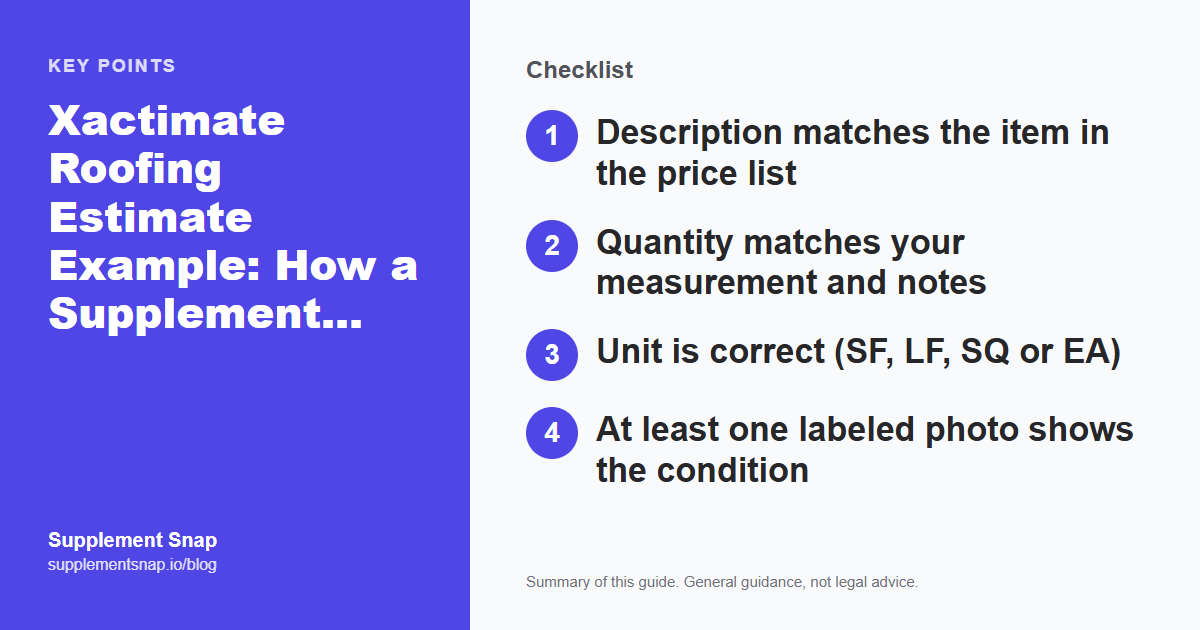
Check each supplement line before sending
Mistakes that get packages sent back
Most rejected or delayed supplements fail on presentation, not on the roof:
Photos that are unlabeled or dark, so the adjuster cannot tell what they show.
Long narratives that never state a quantity.
Submitting items in a random order instead of grouping by roof area.
Sending photos as many separate attachments with no index.
Run the whole package through the free supplement checklist before you send it, and use the roofing supplement template for the cover page and findings layout.
Do not pad the list
A supplement with ten supported items is stronger than one with twenty where half have no proof. Every unsupported line gives the adjuster a reason to question the rest.
Where software fits
Building this list by hand is slow, and mismatches creep in between photos, notes and line items. Supplement Snap links each finding to its photo and note as the crew captures it, and can export Xactimate-style line items as a starting list. You still review everything and decide what goes out.
To see what the finished document looks like, open the sample supplement report. For how an estimating tool and a documentation tool work together, read Xactimate roofing software explained. No tool can guarantee that a supplement is approved. Coverage depends on the claim, the policy and the carrier.
Frequently asked questions
Can I write an Xactimate-style estimate without Xactimate?
You can submit a clearly formatted document that mirrors line items, quantities and units. Building a native Xactimate estimate requires the software.
What price list should I use for a supplement?
Use the one named on the adjuster's estimate for your claim, so each line can be compared directly with the original.
How many supplement items should I include?
Include only the items you can support with photos, measurements and a reason. Padding a list can reduce trust in the whole package.
Should I list the original items again in my supplement?
Show the original estimate for reference, but keep your supplement items in a separate list so the adjuster can see exactly what is new.
Do the example quantities on this page apply to my job?
No. They are fictional and only show structure. Use your own measurements and the price list from your claim.
References & Resources
Free tools and resources
Ready to streamline your supplement process?
Supplement Snap helps your crew capture hidden damage during tear-off and generate adjuster-ready reports in minutes.
Written by
Kelvin Spratt
Founder, Supplement Snap
Kelvin builds software for roofing contractors who are tired of leaving supplement money on the table. His background in software development and insurance restoration workflows drives everything Supplement Snap does.