Flashing, Vents and Pipe Jacks: Documenting Small Items on a Roof Claim
Kelvin Spratt
Founder, Supplement Snap · October 25, 2026 · Updated October 25, 2026
Key Takeaways
Flashing, vents and pipe boots are small items that add up. How to count, photograph and request them in a roofing supplement without missing any.
Preparing a supplement? Use the free checklist so nothing is missing when you submit.
The short answer
Small roof items like pipe boots, vents and flashing are easy to overlook in an estimate. They are also easy to document well if the crew counts and photographs them before tear-off. List each one, its location and its condition, and ask for any that the estimate leaves out.
Disclosure: we make Supplement Snap, which helps roofing crews document damage found at tear-off and export a report. It does not decide coverage, negotiate claims or guarantee approval. This page is general guidance, not legal or claims advice.
Free download
Roof tear-off findings log
A log for the roof: where each finding is, what it is, how much, and which photos show it, with a checklist before you leave.
Fillable PDF: open it in a PDF reader such as Adobe Acrobat Reader to type into the blanks. Some phone and browser previews cannot.
See all free roofing templates →
No email or sign-up needed. General guidance, not legal advice. Adjust it to your carrier's, client's and state's requirements.
Why small items matter
A few missing pieces across a job add up, and an estimate built from aerial images cannot count every penetration. The table lists the items to record. A complete count also helps the crew know what to order.
| Feature | What to record |
|---|---|
| Pipe boots or jacks | Count and size; photo of each |
| Vents | Type and count; condition of each |
| Step and counter flashing | Linear feet along walls and chimneys |
| Chimney and skylight flashing | Each one as its own item, with a photo |
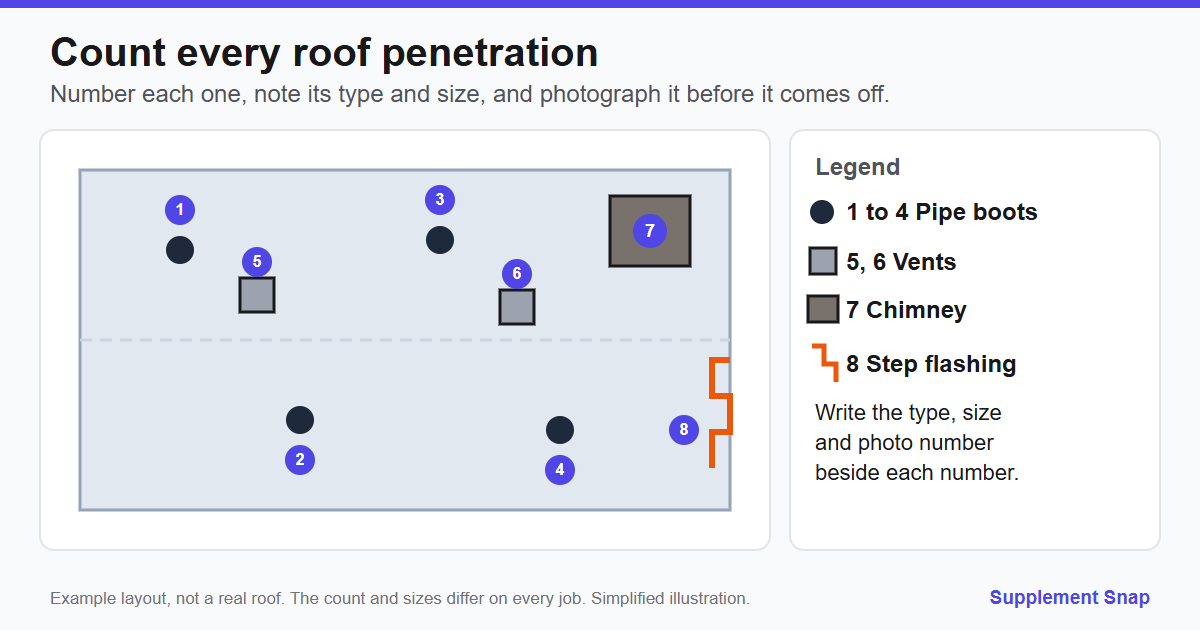
Count every penetration once.
Supplement Snap helps your crew log each item with a photo and location as they find it. Your first project is free.
Counting method
Walk each slope with a clipboard or phone notes. Number each penetration, write its type and size, and photograph it. Use the same numbering in the report so the adjuster can match item to photo.
Flashing
Measure step flashing and counter flashing in linear feet along walls, and record chimneys and skylights as separate items. Note whether existing flashing is damaged, reusable or missing, and show it.
Photograph before removal
Once a pipe boot or vent is removed it is hard to prove what was there. Take the photo first.
Reuse or replace
Carriers and contractors sometimes disagree on whether an item can be reused. Photograph its condition and write down why you replace it, such as corrosion, cracking or a different profile needed for the new roof. Avoid saying it must always be replaced.
How to word the request
Example: Pipe boots, 4, sizes 2 in and 3 in, photos 31 to 34. Step flashing, 36 linear feet along the east wall, photo 35. List each as a numbered finding and give counts.
A worked example (fictional numbers)
On one roof the crew counts four pipe boots (two 2 inch and two 3 inch), three box vents, one chimney with a 6 foot front and two 4 foot sides, and 36 linear feet of step flashing along a sidewall. The crew photographs each item before removal and numbers the photos 31 to 44.
The carrier's estimate lists two pipe boots, two vents and no chimney flashing. The request lists the difference line by line: two additional pipe boots, one additional vent, chimney flashing at 14 linear feet, step flashing 36 linear feet. Each line points to its photo numbers. These counts are an example only.
Reusing versus replacing
Some flashing can be reused when the new roof goes on. Whether it should be depends on its condition and the new roofing. If you replace an item that looks reusable, explain why: corroded, cracked, wrong profile, or sealant that failed. Photograph the problem. If you are not sure, say so rather than overstating.
Roof-to-wall and chimney details
Chimneys and sidewalls take several pieces of flashing. Rather than listing it as one lump, break it into step flashing, counter flashing and a cricket or saddle if the chimney is wide enough to need one. Record each piece's length. Local code and the manufacturer's instructions may call for details that differ from the old installation.
Penetrations that are easy to miss
Walk the roof for bathroom fan vents, kitchen vents, plumbing stacks, attic ventilation, satellite mounts, and electrical masts. A quick pass with a numbered list or a sketch of the roof helps. Photograph each one even if you are not requesting a change, so the file shows the whole roof.
Frequently asked questions
Does insurance pay for pipe boots and vents?
They are often part of a roof replacement estimate. If one is missing, you can document it and ask.
How do I count vents?
Walk each slope, number each vent, and photograph it. Record the type.
Can flashing be reused?
Sometimes. Document its condition and your reason for replacing it.
Do I measure flashing in square feet?
Step and counter flashing are usually measured in linear feet. Check the unit in the estimate.
What if the estimate lumps them together?
Compare your counts to the lumped line and show what is not covered.
Is a pipe boot the same as a pipe jack?
They are two names for the same part: the flashing that seals around a vent pipe where it passes through the roof.
Should I request every vent as a separate item?
Count them and list by type and size. Whether the estimate prices them individually or as a group, your list lets the reviewer match what you installed to what was priced.
References & Resources
Free tools and resources
Ready to streamline your supplement process?
Supplement Snap helps your crew capture hidden damage during tear-off and generate adjuster-ready reports in minutes.
Written by
Kelvin Spratt
Founder, Supplement Snap
Kelvin builds software for roofing contractors who are tired of leaving supplement money on the table. His background in software development and insurance restoration workflows drives everything Supplement Snap does.
More Articles
Replacing Step Flashing Behind Siding: How to Document It
Read more →
What Can You Supplement on a Roof Claim? 12 Items Contractors Commonly Request
Read more →
Roof Inspection Checklist for Roofing Contractors (Printable)
Read more →
Drip Edge on a Roof Claim: How Roofers Document and Request It
Read more →