How to Document Multiple Layers of Shingles During Tear-Off
Kelvin Spratt
Founder, Supplement Snap · October 25, 2026 · Updated October 26, 2026
Key Takeaways
Found a second or third roof layer? How to photograph each layer with a tape, record the count by slope, and send proof for extra labor and disposal.
Preparing a supplement? Use the free checklist so nothing is missing when you submit.
The short answer
When a crew strips the first section of a roof and finds a second or third layer that was not visible from the ground, the job is bigger than the estimate assumed. Extra layers mean more labor, more disposal and sometimes different installation steps. To ask the carrier to reflect that, you need proof the office can use: a clear photo of the stacked edge with a tape, the count by slope, and a note of the material. Take it during tear-off, before the layers are in the trailer.
Disclosure: we make Supplement Snap, which helps roofing crews document damage found at tear-off and export a report. It does not decide coverage, negotiate claims or guarantee approval. This page is general guidance, not legal or claims advice.
Free download
Roof tear-off findings log
A log for the roof: where each finding is, what it is, how much, and which photos show it, with a checklist before you leave.
Fillable PDF: open it in a PDF reader such as Adobe Acrobat Reader to type into the blanks. Some phone and browser previews cannot.
See all free roofing templates →
No email or sign-up needed. General guidance, not legal advice. Adjust it to your carrier's, client's and state's requirements.
Why layers get missed
From the ground, a roof with two layers can look like one. Edges are covered by drip edge or fascia, and the layer count may differ between slopes if part of the roof was repaired or re-roofed at another time. The estimate is usually built from what the adjuster could see and from aerial measurements, so extra layers often show up only once the crew is on the roof. The table lists what to capture the moment you find them.
| Feature | What to capture |
|---|---|
| The edge | A close photo of the cut edge showing every layer stacked, with a tape against it |
| The count | How many layers, on which slope, and where on that slope |
| The type | Shingles, felt, wood shakes or something else, so the office knows what came off |
| The change | A wide photo showing where the extra layers start and stop |
| The proof of work | Photos of the debris or weight tickets from the extra material |
Catch the layers before they hit the dumpster.
Supplement Snap lets your crew photograph and tag each finding by slope the moment it appears. Your first project is free.
Step 1: Photograph the stacked edge
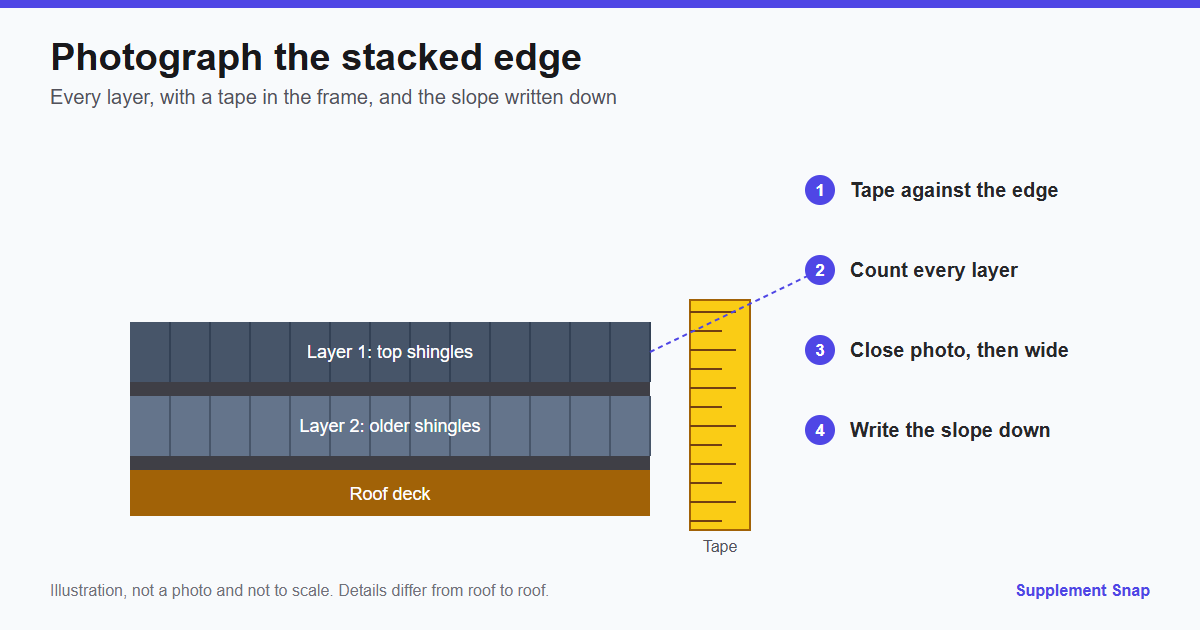
Cut or lift a clean edge so the layers are visible from the side. Hold a tape measure or a marked stick against it. Take one close photo showing every layer and the tape, and one slightly wider photo that shows where on the slope the edge is. If you cannot get a clean side view, photograph the exposed layers as the crew removes them, one at a time, with the slope noted.
Do not rely on a single photo. If a reviewer cannot tell how many layers there are, the photo does not do its job.
Step 2: Count by slope, not by house
Layers can differ across a roof. A rear addition may have one layer while the main roof has two. Write the count for each slope: Front slope, two layers. Rear slope, one layer. Addition, three layers. Then put the quantity of roofing in squares beside each count, if the crew has measured it. Our free findings log has a table for exactly this.
Photograph it before the second layer is gone
The edge is only readable until it is torn off. Take the photo the moment you see more than you expected, and write down the slope while you are standing there.
Step 3: Name what you found
Say what the layers are made of. Asphalt shingles over felt over old shingles is different from wood shakes under newer shingles. Note whether the lower layer looks like a different age or product, and whether you saw anything unusual between layers. Keep it factual: what is there, not why it happened.
Step 4: Keep proof of the extra disposal
Extra layers add weight and loads. Keep dump tickets and dumpster invoices, and photograph the debris pile if useful. Write the claim number or address on each receipt. Our article on debris removal and dumpster costs covers what the carrier may need to see. Building codes, manufacturer instructions, policy wording and carrier practice vary, so confirm the details for your job with the building department and the claim documents.
A worked example (fictional)
A crew starts on the rear slope of a 32 square roof. The lead lifts a shingle at the eave and finds two layers. He walks the roof, finds the same stack on the front slope, and then sees that the garage addition has only one. He photographs the cut edge on each slope with a tape, writes Front 2 layers, Rear 2 layers, Garage 1 layer in the log, and sends the log and photos to the office before lunch.
The office builds a supplement with three numbered findings, each with its edge photo, and compares the tear-off quantity in the estimate with the second-layer quantity. The example is made up. It shows the order: stop, photograph, count by slope, send.
How to word the request
Keep it short and checkable: Second layer of asphalt shingles found on front and rear slopes, 28 squares. Photos 6 to 11 show the stacked edge with a tape. Garage addition has one layer, photo 12. Dump tickets attached.
Ask for the difference between what the estimate lists and what you found. Do not argue about why the adjuster did not see it. The roof was not open when they looked.
A copy-and-paste checklist for the crew lead
Stop as soon as you see more layers than expected
Photograph the cut edge from the side with a tape against it
Take a second photo a step back that shows where on the slope it is
Count the layers and write the number for this slope
Write what each layer is made of
Repeat on every slope, because counts can differ
Keep dump tickets and invoices for the extra disposal
Send the log and photos to the office before the layers are in the trailer
Our free findings log has a row for each of these.
What a reviewer usually needs to see
Someone reviewing a supplement from a desk was not on the roof. They commonly want to be able to answer four questions from your package alone: how many layers, on which slope, of what material, and how much extra material that created. If a photo or a note answers each, there is less reason to send the request back for more information. If the reviewer still has to ask, answer in writing and attach the missing photo. Keep a copy of each exchange.
If the estimate and your count do not match
Compare the carrier's tear-off line with your own count. If the estimate assumes one layer and you found two, write the difference in squares and attach the edge photos. If the quantities are close but not identical, say how you measured, because small differences can come from where each person measured. Ask for the difference in writing, keep the tone factual, and set a follow-up date. See our email template and tracker.
Layers, code and your contract
Many places limit how many layers a roof can carry, and some require all layers to come off when there are already two. Whether that applies to your job depends on the local building code, so ask the building department. Your own contract should also say what happens when hidden layers are found, so the homeowner is not surprised. Neither of those decides what the carrier pays, but both are good records to have. Building codes, manufacturer instructions, policy wording and carrier practice vary, so confirm the details for your job with the building department and the claim documents.
Mistakes that weaken the proof
One photo of the edge with no tape and no slope noted
A count for the whole house when slopes differ
Photos taken after the layers were already in the dumpster
No receipts for the extra disposal
Claiming a layer you did not photograph
Frequently asked questions
Does insurance pay for an extra layer of shingles?
Sometimes. It depends on the policy, local code, and what the carrier accepts after reviewing your photos and quantities. Document it clearly and ask.
How do I prove how many layers there were?
Photograph the cut edge with a tape against it, and write the count for each slope with the photo numbers.
Do layers have to be removed?
Many places limit how many layers a roof can have, and shingle manufacturers give installation instructions. Check your local code and the manufacturer's sheet for the product you install.
What if only part of the roof has two layers?
Document each slope separately. Quantities and counts by slope are what the reviewer needs.
Should I keep the dump tickets?
Yes. They show the extra weight and loads and support the disposal line.
Can I add this to a supplement after the first estimate?
Many contractors do. Send the photos, counts and receipts together and follow the carrier's process.
How many layers of shingles can a roof have?
It depends on local code and the roof's condition. Many places require removing all layers when there are already two, and shingle makers give their own installation instructions. Ask your building department for the rule in your area.
How do I tell shingle layers from underlayment?
Layers of shingles are thick, granule-covered courses stacked on each other. Underlayment is a thin sheet, usually felt or synthetic, between the shingles and the deck. Photograph the edge and label each layer so the difference is clear.
Can I charge more for an extra layer?
That depends on your contract and the carrier's review. Write the contract so hidden conditions are addressed, and document the extra layer with photos and quantities either way.
References & Resources
Free tools and resources
Ready to streamline your supplement process?
Supplement Snap helps your crew capture hidden damage during tear-off and generate adjuster-ready reports in minutes.
Written by
Kelvin Spratt
Founder, Supplement Snap
Kelvin builds software for roofing contractors who are tired of leaving supplement money on the table. His background in software development and insurance restoration workflows drives everything Supplement Snap does.