Roof Leak Insurance Claims: What Contractors Should Know
Kelvin Spratt
Founder, Supplement Snap · October 23, 2026 · Updated October 23, 2026
Key Takeaways
What contractors should know about roof leak insurance claims: finding the source, documenting damage, temporary protection and why cause decides coverage.
Preparing a supplement? Use the free checklist so nothing is missing when you submit.
The short answer
A roof leak insurance claim usually turns on the cause. Many policies respond to sudden, accidental damage, such as a storm opening a path for water, and may not respond to damage from long-term wear, poor maintenance or repeated seepage. Contractors help by finding and documenting the source, protecting the property from further damage and keeping clear records.
The insurer decides coverage. This guide is general information, and policies differ, so read the actual policy language.
Free download
Roof damage report template
Job details, roof summary, numbered findings, recommendations, a photo index and a photo checklist.
Fillable PDF: open it in a PDF reader such as Adobe Acrobat Reader to type into the blanks. Some phone and browser previews cannot.
See all free roofing templates →
No email or sign-up needed. General guidance, not legal advice. Adjust it to your carrier's, client's and state's requirements.
Why the cause matters so much
Two leaks that look the same can be treated differently. A leak from storm damage, for example a section of shingles torn off, is often evaluated as a sudden event. A leak from aged flashing, failed sealant or worn roofing may be evaluated as wear or maintenance.
Your role is not to rule on that. It is to record what you observe: the condition of the roof, the location of the opening, the state of the surrounding materials and the interior damage. The comparison shows the kinds of evidence that tend to point one way or the other, and it is for orientation, not a coverage test.
Signs pointing to a sudden event
- Recent storm with matching date
- Fresh damage such as a missing or torn shingle
- Interior stain that appeared recently
- Damage localized near the opening
Signs pointing to long-term conditions
- Widespread wear or granule loss
- Old, dried or repeated stains
- Rust, rot or mold suggesting a long history
- Failed sealant or aged flashing
Stay in your lane on coverage
It is tempting to reassure a homeowner by saying a leak will be covered, or to warn them it will not. Avoid both. You do not know the policy terms, and the carrier decides. Stick to factual statements about what you found and what repair is needed.
That approach also protects you. If a claim is denied after you promised coverage, the trust that cost you is hard to rebuild.
Describe the cause, do not decide coverage
Whether a leak is covered depends on the policy and the cause of loss. Record what you see and let the carrier make the coverage decision. Avoid telling a homeowner a leak is or is not covered.
Protect the property first
Policies commonly expect the policyholder to take reasonable steps to prevent further damage. Temporary protection, such as tarping an opening or stopping active water entry, is usually part of that. Do it safely.
Document the condition before you cover anything, then photograph the temporary repair. Keep invoices and receipts. A clear record shows what was done and why. Check the policy and the carrier's instructions on whether and how temporary repair costs are handled.
Stop further damage
Tarp or temporarily protect the opening when it is safe to do so.
Photograph before and after
Capture the condition before any temporary repair, then the repair itself.
Keep receipts
Save invoices and material receipts for temporary protection.
Notify the insurer
The policyholder reports the loss and follows the policy's instructions.
Finding and recording the source
Water often travels along rafters, decking or insulation before it appears inside, so the stain may not sit directly under the opening. Trace carefully. Common sources include flashing at chimneys and walls, pipe boots, valleys, damaged shingles and penetrations.
Record your reasoning in plain terms: where the water was entering, what evidence you saw and what you could not confirm. Saying that you could not determine something is better than guessing.
Documentation checklist
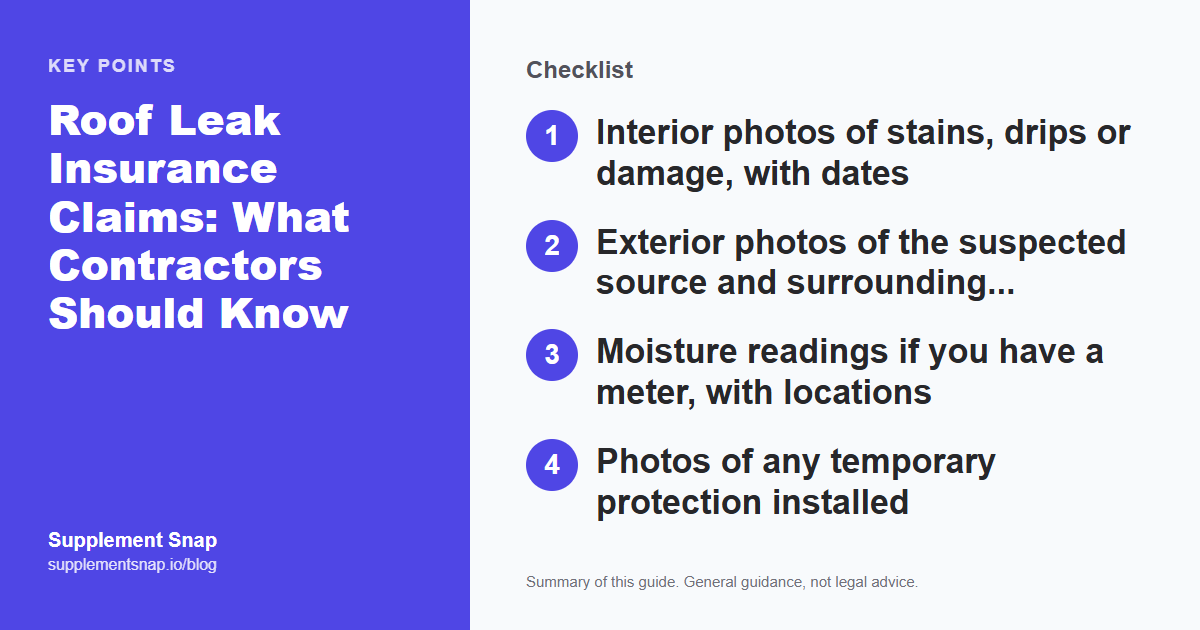
A complete leak file includes interior and exterior photos, notes on the roof's age and condition, any moisture readings, photos of temporary protection and every receipt. Date everything.
If the repair leads to a bigger scope of work, or hidden damage appears when the roof is opened, the same habits support a supplement. See how to document rotted roof decking and the free supplement checklist.
Leak documentation checklist
Where Supplement Snap fits
Supplement Snap helps crews capture photos, notes and areas on site and organize them into a report for the adjuster. It does not decide coverage. For the wider process, see how roofing contractors work insurance claims.
Frequently asked questions
Does homeowners insurance cover a roof leak?
It depends on the policy and the cause. Policies often respond to sudden, accidental damage and may not cover damage from long-term wear or maintenance issues. Read the policy language.
What should a contractor do first on a roof leak claim?
Protect the property from further damage when it is safe, and document the condition before and after any temporary repair, keeping receipts.
Should I tell the homeowner the leak will be covered?
No. Coverage is decided by the insurer. Describe what you found and let the carrier decide.
How do you find where a roof leak is coming from?
Trace the water from the interior stain along the likely path to the exterior, checking flashing, penetrations, valleys and damaged roofing. Record what you can and cannot confirm.
Are temporary repair costs reimbursed?
It depends on the policy. Keep receipts and check the policy and the carrier's guidance.
References & Resources
Free tools and resources
Ready to streamline your supplement process?
Supplement Snap helps your crew capture hidden damage during tear-off and generate adjuster-ready reports in minutes.
Written by
Kelvin Spratt
Founder, Supplement Snap
Kelvin builds software for roofing contractors who are tired of leaving supplement money on the table. His background in software development and insurance restoration workflows drives everything Supplement Snap does.