How Roofing Contractors Work Insurance Claims: A Step-by-Step Guide
Kelvin Spratt
Founder, Supplement Snap · October 23, 2026 · Updated October 23, 2026
Key Takeaways
How roofing contractors work insurance claims from the first inspection to final payment: the steps, the contractor's role, documentation and supplements.
Preparing a supplement? Use the free checklist so nothing is missing when you submit.
The short answer
Roofing contractors work insurance claims by documenting the roof's condition, providing an estimate, supporting the homeowner while the insurance adjuster reviews the damage, and then submitting a supplement if hidden damage turns up during the work. The insurer decides what is covered and how much it pays. The contractor's job is to make the roof's condition and the cost of repair clear and verifiable.
This guide walks through that workflow from the first inspection to the final payment. It is general information, not legal or insurance advice. Rules differ by state, carrier and policy, so confirm the specifics for your area.
The claim workflow in six steps
Every claim is a little different, but most follow the same path. Understanding the sequence helps you know where your documentation matters and when to expect questions.
The homeowner starts the claim with their insurer. The adjuster reviews the damage and builds an estimate. If your findings differ from that estimate, you raise the differences with supporting evidence. When work begins, conditions that were hidden may surface, and a supplement addresses them. Payment timing depends on the policy, including whether it pays actual cash value first and releases the rest after the work is complete.
Homeowner reports the claim
The policyholder contacts the insurer, who assigns an adjuster and a claim number.
Contractor inspects and documents
Photos, measurements and notes record the roof's condition before any work starts.
Adjuster inspects and estimates
The carrier's adjuster reviews the damage and writes an estimate under the policy.
Estimate is compared and discussed
Differences between the contractor's findings and the estimate are reviewed with the adjuster.
Work begins and hidden damage is documented
Concealed conditions found at tear-off are photographed and measured.
Supplement and final payment
Additional items are submitted, and remaining payments are released according to the policy.
What the contractor's role is, and where it stops
A contractor's role is practical and evidence-based:
Inspect and document: Photos, measurements and a factual description of the roof's condition.
Provide an estimate: Scope and price for the repair or replacement.
Support the homeowner: Explain what you found and be available when the adjuster inspects.
Document hidden damage: Record conditions found during tear-off and submit them as a supplement.
Where it stops matters just as much. Deciding coverage belongs to the insurer. Depending on the state, negotiating a claim on a homeowner's behalf may require a public adjuster license. Staying within what you can document and estimate protects you and the homeowner.
Know your state's rules on contractors and claims
In many states, contractors may not negotiate a claim on a homeowner's behalf unless they hold the right license, and other rules apply to fees and contracts. Check your state insurance department before you act beyond documenting and estimating.
The first inspection: what to record
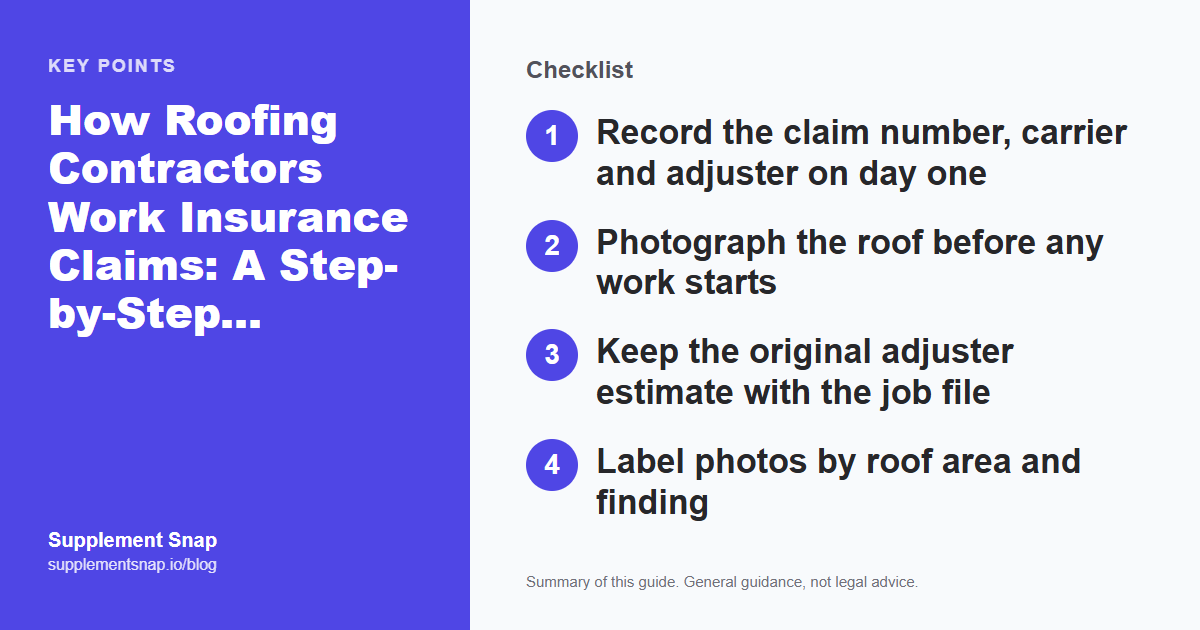
Your first visit sets the baseline for everything that follows. Photograph every slope, then the specific areas of concern. Include flashing, vents and penetrations. Note the roof's approximate age, the number of layers if you can tell and any visible wear separate from the reported damage.
Be honest in your notes. If you see old wear that is not related to the storm, record it as such. A balanced record is more credible, and credibility helps when you later ask the adjuster to consider additional items. The roof damage report template gives you a structure to follow.
Working with the adjuster
Adjusters handle many claims and respond best to organized, specific information. Some practical habits:
Be present when you can: With the homeowner's permission, being on site during the adjuster's inspection lets you show what you found.
Compare estimates line by line: Note what is missing or different, not just the total.
Offer evidence, not arguments: Photos, measurements and references beat opinions.
Ask for reasons in writing: If something is denied, the stated reason tells you what to document next.
Keep a record: Dates, names and what was said.
For the evaluation side, read how adjusters determine roof damage.
Habits that keep claims moving
Hidden damage and supplements
The first estimate is based on what could be seen. Once the old roofing comes off, you may find damaged decking, failed flashing, missing underlayment or extra layers. A supplement is the documented request for those additional costs.
The strength of a supplement is its proof: labeled photos taken before the condition is covered, measurements that match your notes and a short factual explanation. For the full picture, see what a supplemental roofing estimate is and how to write a roofing supplement.
Payment and closing the claim
Payments follow the policy. Many policies pay actual cash value first, then release recoverable depreciation when the work is finished and documented. Final invoices, completion photos and any supplement approvals feed into that last step.
Track every open claim so none stalls. A simple tracker such as the roofing supplement follow-up log keeps submissions, responses and next steps in one place.
Where Supplement Snap fits
Supplement Snap helps crews capture photos, areas and notes on the roof, organize findings by claim and produce a report for the adjuster. It supports the documentation part of this workflow. It does not decide coverage or guarantee approval. See the sample report.
Frequently asked questions
How do roofing contractors work with insurance companies?
They document the roof's condition, provide an estimate, support the homeowner during the adjuster's review and submit supplements for hidden damage found during the work. The insurer decides coverage and payment.
Can a roofer negotiate with the insurance company for me?
It depends on the state. In many places, negotiating a claim for a homeowner requires a public adjuster license. Contractors can usually document and estimate but should check local rules.
What is the roofing insurance claim process?
The homeowner reports the claim, the adjuster inspects and estimates, the contractor documents and compares findings, work begins, hidden damage is supplemented, and payments are released under the policy terms.
Does the contractor or the insurer decide what is covered?
The insurer decides, based on the policy and the claim. The contractor provides evidence and an estimate.
What documentation do I need for a roof insurance claim?
Labeled photos, measurements, notes on each finding, the adjuster's estimate and a record of all communication.
References & Resources
Free tools and resources
Ready to streamline your supplement process?
Supplement Snap helps your crew capture hidden damage during tear-off and generate adjuster-ready reports in minutes.
Written by
Kelvin Spratt
Founder, Supplement Snap
Kelvin builds software for roofing contractors who are tired of leaving supplement money on the table. His background in software development and insurance restoration workflows drives everything Supplement Snap does.
More Articles
A Crew SOP for Supplement Documentation (Free Checklist)
Read more →
Can a Roofer Talk to the Insurance Company? What Contractors May and May Not Do
Read more →
What Is a Supplemental Roofing Estimate? When It Applies and What It Includes
Read more →
How Insurance Adjusters Determine Roof Damage (and What Documentation Helps)
Read more →