Storm Damage Roof Repair: What Contractors Need to Know in 2026
Kelvin Spratt
Founder, Supplement Snap · March 20, 2026
Storm Damage Market
$15B+
Annual U.S. insurance payouts for storm-related roof damage
Key Takeaways
Complete guide to storm damage roof repair for contractors. Learn how to identify wind, hail, and debris damage, navigate insurance claims, and maximize recovery on every storm job.
Understanding storm damage roof repair
Storm damage roof repair is one of the highest-volume, highest-revenue segments in residential roofing. Every year, severe weather events across the United States generate more than $15 billion in insurance payouts for roof damage alone. For contractors who understand how to identify storm damage, document it properly, and navigate the insurance claims process, storm season represents a massive business opportunity.
But storm damage roofing is fundamentally different from retail roofing. The customer is not paying out of pocket. The insurance company is funding the repair based on their adjuster's estimate. That means your revenue depends not just on the quality of your work, but on the quality of your documentation. Miss a finding during inspection, fail to photograph hidden damage during tear-off, or submit a weak supplement, and you leave money on the table.
This guide covers the types of storm damage you will encounter, how insurance claims work for storm damage repairs, what hidden damage looks like during tear-off, and how to maximize your recovery on every storm job.
Wind Damage
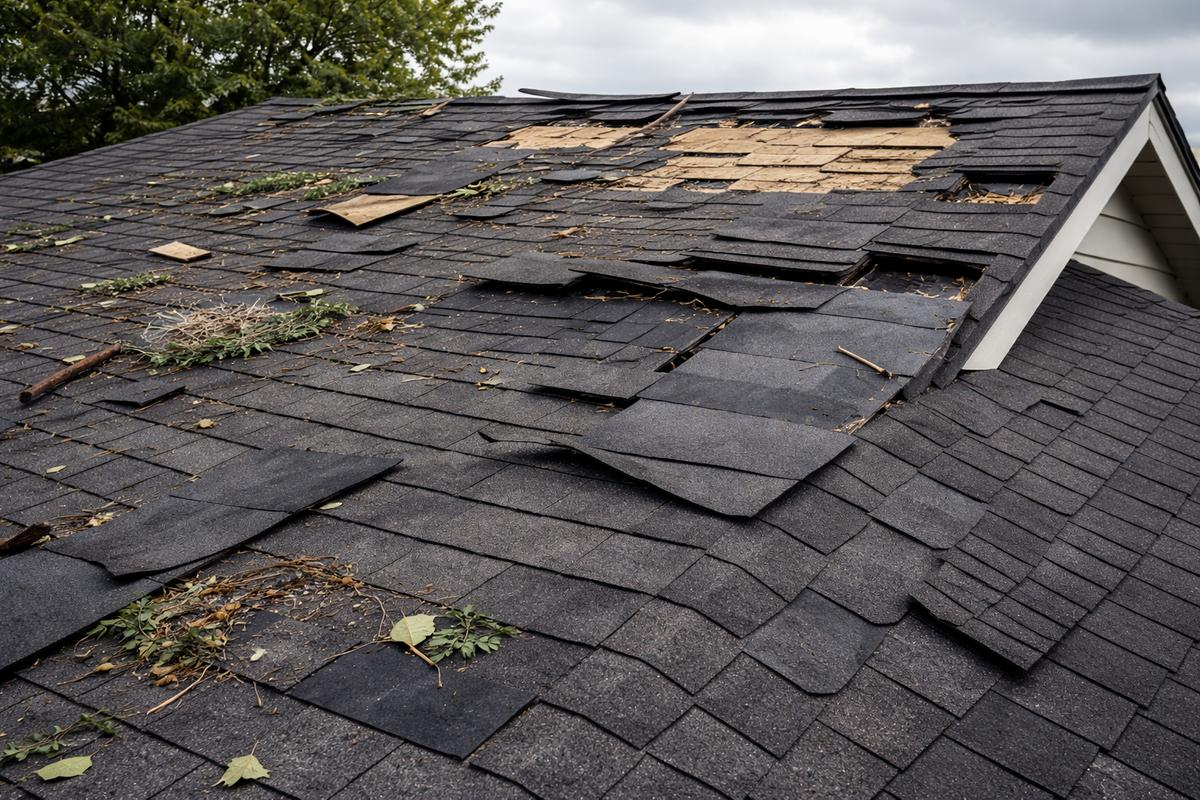
Lifted, creased, or missing shingles caused by high winds. Often starts at edges and ridgelines where uplift pressure is greatest.
Hail Damage
Bruised or fractured shingles with exposed fiberglass mat. May appear as dark spots, dents, or granule displacement on impact zones.
Debris Impact
Punctured or cracked roofing materials from fallen tree limbs, branches, and airborne objects during severe storms.
Water Intrusion
Moisture penetration through compromised flashings, damaged shingles, or failed ice and water shield. Often causes concealed decking rot.
Flashing Failure
Bent, displaced, or separated flashings around chimneys, walls, and penetrations caused by wind uplift and thermal cycling during storms.
Drip Edge Damage
Bent or detached drip edge along eaves and rakes, often caused by wind-driven debris or ice damming after winter storms.
Types of storm damage to roofing systems
Storm damage to roofing systems falls into several categories, each with distinct visual indicators and documentation requirements. Understanding these categories is critical for thorough inspections and complete insurance claims.
Wind damage is the most common form of storm damage. High winds create uplift pressure that lifts shingle tabs, breaks the seal strip bond, and in severe cases tears shingles completely off the roof. Wind damage typically starts at the most vulnerable points: ridgelines, eaves, rakes, and corners where uplift forces are strongest. Look for creased shingles, lifted tabs, missing shingles, and exposed underlayment or decking.
Hail damage varies depending on hail size, wind speed, roof age, and shingle type. Hailstones 1 inch in diameter or larger typically cause functional damage to asphalt shingles. Signs include random dents or bruises in the shingle surface, displaced granules exposing the fiberglass mat, fractures in the shingle, and dents in soft metals like flashing, vents, and gutters. Hail damage is often subtle and requires a trained eye to distinguish from normal wear.
Debris impact damage results from tree limbs, branches, and airborne objects striking the roof during storms. This can range from minor granule loss to punctured shingles and cracked decking. Debris impacts are usually obvious but the full extent of damage beneath the impact point may not be visible until tear-off.
Water intrusion damage occurs when storm damage compromises the roof's water-shedding system. Damaged shingles, displaced flashing, and failed sealants allow water to penetrate the roofing system. Over time, this causes decking rot, mold growth, and insulation damage. Water intrusion damage is almost always concealed and is one of the most common supplement items discovered during tear-off.
How insurance claims work for storm damage
The insurance claims process for storm damage roof repair follows a predictable sequence, but each stage presents opportunities for contractors who are prepared.
The process begins when the homeowner files a claim with their insurance carrier after a storm event. The carrier assigns a claim number and schedules an adjuster to inspect the property. As the contractor, your role at this stage is to perform your own inspection, document all visible damage, and provide the homeowner with a professional inspection report they can share with their adjuster.
When the adjuster arrives, they inspect the property and write an initial estimate using Xactimate. This estimate covers only the damage visible during their inspection. If you can be present during the adjuster's inspection, do it. Walk the roof with them, point out damage they might miss, and make sure they document every affected component.
The initial estimate rarely covers the full cost of the repair. Why? Because the adjuster inspects the roof from the surface. They cannot see what is under the shingles. Rotted decking, failed underlayment, corroded flashing, deteriorated pipe boots: these are all concealed by the existing roofing materials and only become visible during tear-off.
This is where supplements come in. When your crew tears off the existing roof and discovers hidden damage, you document it and submit a supplement to the insurance company requesting additional payment. The supplement includes photos, a written narrative describing the damage, and Xactimate line items with the correct codes and quantities.
A well-documented supplement is almost always approved because the damage is real, verifiable, and was concealed before tear-off. The average supplement on a storm damage job recovers $1,500 to $3,200 in additional revenue.
Storm event occurs
Document the storm date and severity. Save weather reports, hail maps, and any alerts for the area. This establishes the loss date for the claim.
Initial property inspection
Inspect the roof for visible storm damage. Photograph all findings with wide shots for context and close-ups for detail. Note every damaged component.
Insurance claim filed
Help the homeowner file the claim with their carrier. Include your inspection report and photos. The carrier assigns an adjuster and a claim number.
Adjuster inspection
The insurance adjuster inspects the property and writes the initial estimate. Be present if possible to point out damage they might miss.
Tear-off reveals hidden damage
During tear-off, your crew discovers concealed damage: rotted decking, failed underlayment, corroded flashing. Document everything immediately.
Supplement submitted
Submit a professional supplement with photos, narratives, and Xactimate line items for all hidden damage found during tear-off.
Supplement approved and paid
The adjuster reviews and approves the supplement. Payment is issued to cover the additional cost of hidden damage repairs.
Hidden damage found during tear-off after storms
Hidden damage is the single biggest revenue opportunity in storm damage roof repair. Studies consistently show that 70 to 90 percent of storm damage tear-offs reveal damage that was not included in the original insurance estimate. This is not fraud or exaggeration. It is the reality of roofing: you cannot see what is under the shingles until you remove them.
The most common types of hidden damage found during tear-off include:
Rotted or deteriorated decking: Plywood or OSB sheathing that has absorbed moisture through damaged shingles. The wood is soft, spongy, or crumbling. This requires full sheet replacement before new roofing materials can be installed.
Failed or missing underlayment: Roofing felt or synthetic underlayment that has deteriorated, torn, or was never installed properly. Building codes require underlayment, so replacement is mandatory.
Corroded or damaged step flashing: Step flashing along chimneys and sidewalls that has rusted through, bent, or separated from the wall. Water follows the flashing path, so failed flashing almost always means water damage to the wall sheathing behind it.
Deteriorated pipe boots: Rubber pipe boot seals that have cracked, split, or pulled away from the pipe. Failed pipe boots are one of the most common leak sources and are almost always concealed beneath the shingle layer.
Missing or inadequate ice and water shield: In cold climates, building codes require ice and water shield in valleys, at eaves, and around penetrations. Many older roofs were installed before these requirements existed, and replacement is required by current code.
Additional layers of roofing: Some roofs have a second or even third layer of shingles installed over the original. The additional layer must be removed, and the extra labor and disposal costs should be covered by the insurance claim.
Each of these findings is a legitimate supplement item. The key is documenting them properly at the moment of discovery.
Storm Damage Revenue Per Job (Example: 30 SQ Roof)
Documentation requirements for storm damage claims
Documentation is what separates contractors who recover $1,500 or more per job in supplements from those who recover nothing. The adjuster reviewing your supplement was not on your roof. They need to see clear, compelling evidence of concealed damage.
For every finding, your documentation should include:
Wide-angle context photos showing where on the roof the damage is located
Close-up detail photos showing the specific condition of the damaged material
Measurements: square footage of affected decking, linear feet of damaged flashing, number of failed pipe boots
A written narrative explaining what was found, where it was found, when it was discovered (during tear-off), and why it was not visible during the initial inspection
The corresponding Xactimate line codes with accurate quantities and current pricing
The narrative is especially important. A photo of rotted decking is good. A photo of rotted decking with a narrative stating 'During tear-off operations on March 15, 2026, three sheets of 1/2-inch CDX plywood along the eave edge of the front slope were found to be severely deteriorated from prolonged moisture exposure. The damage was concealed beneath the existing shingle layer and was not visible during the initial inspection.' That gets approved.
Timeliness also matters. Submit your supplement the same day you discover the damage, or within 24 to 48 hours at most. Supplements submitted weeks after the job raise red flags with adjusters and are far more likely to be denied or questioned.
How to maximize recovery on storm damage jobs
Maximizing recovery on storm damage roof repair is not about inflating claims. It is about being thorough, accurate, and professional in your documentation so that every legitimate finding is captured, submitted, and paid.
Here are the practices that separate top-performing storm damage contractors from the rest:
Train your crews to stop and document: When the crew finds hidden damage during tear-off, they need to pause and capture it before it gets covered by new materials. Five minutes of documentation can mean hundreds or thousands of dollars in supplement revenue.
Use a systematic approach: Don't rely on memory or random photos. Use a consistent process for every finding: tag the damage type, record the roof area, take context and detail photos, and add a description.
Know your Xactimate codes: Submit supplements in the language adjusters speak. Use the correct line codes, proper units (SF for decking, LF for flashing, EA for pipe boots), and current regional pricing.
Reference building codes: When a repair is required by current building code (ice and water shield in valleys, proper flashing at penetrations), cite the code. This makes it much harder for the adjuster to deny the line item.
Submit complete packages: Don't send a bare Xactimate estimate. Include a professional PDF report with photos, narratives, a findings summary, and the Xactimate line items. The easier you make the adjuster's job, the faster you get approved.
Track your supplements: Know which supplements are pending, which have been approved, and which need follow-up. A supplement that sits unanswered for 30 days is money you are not collecting.
Pro Tip: Seasonal Storm Preparation
Build your storm response system before storm season hits. Train crews on damage documentation, pre-load your supplement workflow, and establish relationships with adjusters in your area. Contractors who respond within 48 hours of a storm event close 3x more jobs than those who wait a week or more.
Streamlining storm damage documentation with Supplement Snap
Storm damage roof repair is a volume business. During peak storm season, you may have dozens of jobs in progress simultaneously, each with its own hidden damage findings, supplement documentation, and insurance communication. Managing this manually with camera rolls, text messages, and spreadsheets is not scalable.
Supplement Snap was designed for exactly this scenario. During tear-off, your crew opens the app and captures each finding in seconds: a photo tagged with the damage type (decking, flashing, pipe boot, ice and water shield) and the roof area (front slope, back slope, valley, chimney). They can add a voice note describing the damage in any language, and the system auto-translates Spanish voice notes to English.
From those field captures, Supplement Snap generates a professional supplement package:
AI-written damage narratives in the language adjusters expect
Xactimate line items with correct codes, quantities, and current regional pricing
An Xactimate-compatible CSV the adjuster can import directly into their system
A branded PDF report with photos, narratives, and a findings summary, ready to email
The entire process from discovering hidden damage on the roof to sending a complete supplement to the adjuster takes minutes. Your crew documents as they work, and Supplement Snap handles the rest. On storm damage jobs where speed and volume matter most, that efficiency is the difference between recovering thousands in supplements and leaving money on every roof.
For a complete contractor guide to all damage types, see roof damage repair guide.
References & Resources
Ready to streamline your supplement process?
Supplement Snap helps your crew capture hidden damage during tear-off and generate adjuster-ready reports in minutes.
Written by
Kelvin Spratt
Founder, Supplement Snap
Kelvin builds software for roofing contractors who are tired of leaving supplement money on the table. His background in software development and insurance restoration workflows drives everything Supplement Snap does.