Steep Roof and High Roof Charges: How to Document Them
Kelvin Spratt
Founder, Supplement Snap · October 25, 2026 · Updated October 25, 2026
Key Takeaways
Steep-pitch and multi-story roofs take more labor and safety gear. Learn how to measure pitch, photograph it, and request steep and high charges.
Preparing a supplement? Use the free checklist so nothing is missing when you submit.
The short answer
Steeper roofs take more time and more safety setup, and so do roofs that are high above the ground. Many pricing systems include charges for steep pitch and for roof height. The carrier's estimate may include them, partly include them or leave them out. A contractor documents the pitch and height of each area so the right charge can be checked.
Disclosure: we make Supplement Snap, which helps roofing crews document damage found at tear-off and export a report. It does not decide coverage, negotiate claims or guarantee approval. This page is general guidance, not legal or claims advice.
Free download
Roof tear-off findings log
A log for the roof: where each finding is, what it is, how much, and which photos show it, with a checklist before you leave.
Fillable PDF: open it in a PDF reader such as Adobe Acrobat Reader to type into the blanks. Some phone and browser previews cannot.
See all free roofing templates →
No email or sign-up needed. General guidance, not legal advice. Adjust it to your carrier's, client's and state's requirements.
What carriers usually check
The table lists what to record. Estimating software groups pitch into ranges, and the ranges and names depend on the price list in use. Check the price list on your claim for the categories rather than assuming.
| Feature | What to record |
|---|---|
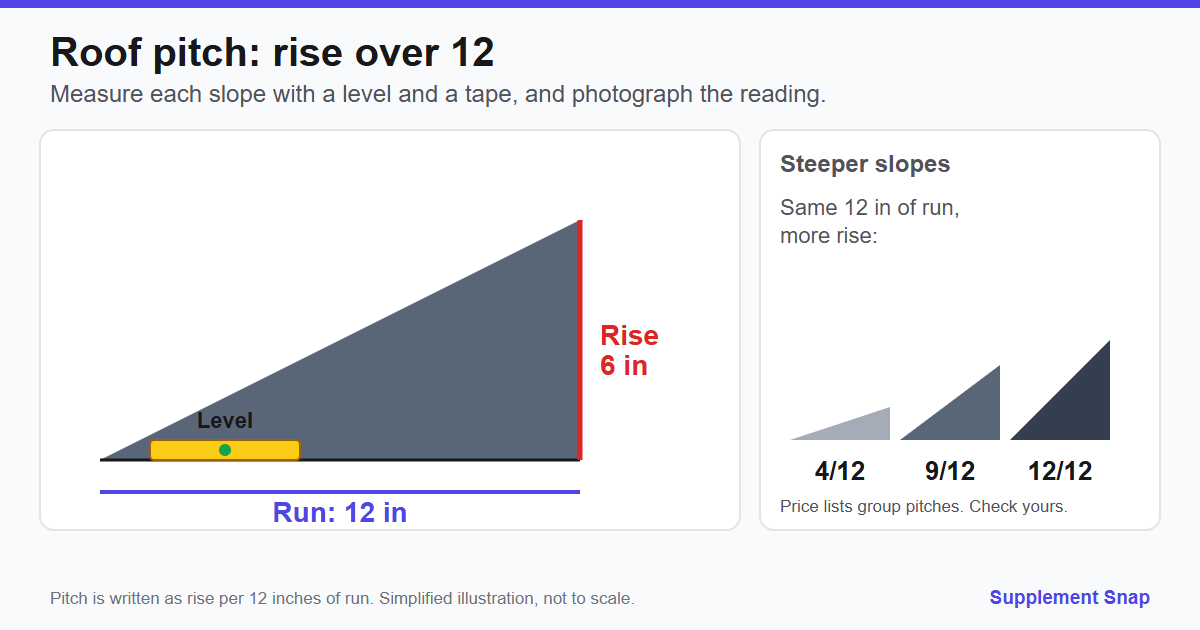
| Pitch | Rise over run for each slope, with a photo of the measurement |
| Area at each pitch | Square footage of each slope so charges apply to the right area |
| Height | Number of stories and eave height at each side of the house |
| Safety and access | Anything that needs added setup, such as roof jacks or fall protection, written down |
Pitch and height, proven on site.
Supplement Snap helps your crew record roof details with photos and notes for the report. Your first project is free.
How to measure pitch
Use a level and a tape, a pitch gauge or an app on a phone, and take a photo that shows the reading. Do it for each slope that differs. Write the pitch beside the slope and the square feet of that slope.
If the carrier's report used drone or satellite measurements, compare them with what you measured and note any difference without guessing why.
Documenting height
Photograph each side of the house from the ground showing the eave height, and note the number of stories. If a section is above two stories, say so and show it. A wide photo with a person or a ladder for scale is more convincing than a number alone.
Measure each slope, not the house
Different slopes often have different pitches. A single pitch for the whole roof can undercount or overcount the charge.
Safety setup and what to claim
Roof jacks, harnesses and anchors are part of working on steep roofs. Whether they are separately payable depends on the price list and the carrier. Record what your crew actually used and why, and do not add items to the request that you cannot show.
How to word the request
Example: Steep charge, rear slope, 9/12 pitch measured, 760 sq ft. Photo 4 shows the reading. High roof charge, rear section above two stories, 480 sq ft, photo 5.
List each area as its own line with its own pitch or height. That makes it simple for the adjuster to check one against the estimate.
A worked example (fictional numbers)
A house has a main roof with a 6/12 pitch and a rear addition with a 10/12 pitch. The rear addition is two stories at the back and measures 520 square feet. The main roof measures 2,400 square feet.
The contractor measures each slope with a level and tape, records the readings with photos, and lists the pitch beside the area: Main roof, 6/12, 2,400 sq ft. Rear addition, 10/12, 520 sq ft. If the price list adds a charge for the pitch range that includes 10/12, the request is for that charge on the 520 square feet, not on the whole roof. The charge categories and their ranges come from the price list on the claim, so check them there.
Why per-slope measurements matter
A single pitch for the whole roof can lead to a charge on every square when only part of the roof qualifies, or to no charge when only part of the roof is steep. Reviewers check this because it changes the total. Breaking it down by slope shows you measured, and it makes your request easy to verify.
Measuring safely
Do not climb a steep roof to measure it if it is unsafe. A pitch gauge, a level on a straight board, or a measurement from the attic rafters can give the rise and run without walking the slope. If you use aerial reports, treat their pitch as a starting point and say in your notes whether you confirmed it on site.
What belongs in the photo
Show the level or gauge against the roof surface, with the reading visible. Include something that shows which slope it is, such as the chimney or a vent. A second photo from the ground showing the whole slope helps the reviewer match the reading to the area.
Frequently asked questions
What is a steep roof charge?
It is an added charge in many pricing systems for the extra labor and safety work on roofs above a certain pitch.
How steep is steep?
The ranges depend on the price list. Check the one in use on the claim.
What is a high roof charge?
It is an added charge for roofs high off the ground, such as above one or two stories. The thresholds depend on the price list.
How do I prove the pitch?
Photograph a level and tape or gauge showing the reading on each slope, and write it down next to the square footage.
Will the carrier always pay it?
No. The carrier reviews each request under the policy and its own process.
Is a steep charge the same as a high roof charge?
No. Steep charges depend on pitch. High roof charges depend on height above the ground. A roof can qualify for one, both or neither, and the price list defines the ranges.
Do I need to measure pitch if the estimate already lists it?
If the carrier's estimate lists a pitch, confirm it on site. If it differs from your measurement, note both numbers and your photo.
References & Resources
Free tools and resources
Ready to streamline your supplement process?
Supplement Snap helps your crew capture hidden damage during tear-off and generate adjuster-ready reports in minutes.
Written by
Kelvin Spratt
Founder, Supplement Snap
Kelvin builds software for roofing contractors who are tired of leaving supplement money on the table. His background in software development and insurance restoration workflows drives everything Supplement Snap does.