Roofing Damage Documentation for Spanish-Speaking Crews
Kelvin Spratt
Founder, Supplement Snap · October 24, 2026 · Updated October 24, 2026
Key Takeaways
How Spanish-speaking roofing crews can document tear-off damage for insurance supplements in their own language, and what to check in the English text.
Preparing a supplement? Use the free checklist so nothing is missing when you submit.
The short answer
Many roofing crews speak Spanish, and the person who sees the damage best is often the one on the roof. If that crew member has to write the note in English, the detail gets lost. A better approach is to let them describe the damage in Spanish and have the app translate it, then have someone review the English before it goes in a supplement.
Disclosure: we make Supplement Snap, which works this way. We describe how it works, not how accurate it is.
Free download
Roofing crew documentation checklist
A one-page routine for before tear-off, during tear-off and before the crew leaves.
Fillable PDF: open it in a PDF reader such as Adobe Acrobat Reader to type into the blanks. Some phone and browser previews cannot.
See all free roofing templates →
No email or sign-up needed. General guidance, not legal advice. Adjust it to your carrier's, client's and state's requirements.
Why the language of the note matters
The adjuster reads English, but the person who found the rotted decking may think and speak Spanish. When they type a short English note to be quick, it often says only 'bad decking'. That is not enough proof for a supplement.
A spoken note in their own language is usually longer and more specific. It can say where the damage is, how far it runs, what it looks like and why it was not visible before tear-off. That detail is what makes a finding clear to the adjuster. Our guide to documenting rotted decking lists what to say.
Let the crew speak the way they work.
Supplement Snap lets crew members record notes in Spanish and translates them to English for the report. Your first project is free.
How it works in Supplement Snap
In the app, a crew member photographs a finding, tags the damage type and roof area, and records a note by voice. The language picker lists Spanish along with Portuguese, French, Polish, Russian, Ukrainian, Vietnamese, Chinese and English. Voice recognition uses the phone or browser's speech recognition, so how well it works depends on the device.
If the note is not in English, the app sends the text to an AI translation step that returns an English version. You see the English text and can edit it. The draft explanation is then written from that note.
The steps below show the flow. We have not published accuracy figures for the voice recognition or the translation, and we do not claim any.
Photograph the damage
Take the photo on the roof and tag the damage type and roof area.
Speak the note
Choose the language in the app and record the note out loud.
Review the English
Read the translated text, fix anything that is wrong, and add detail if it is thin.
Generate and review the draft
The app drafts the explanation from the note. Read it before it goes anywhere.
What to check in the English text
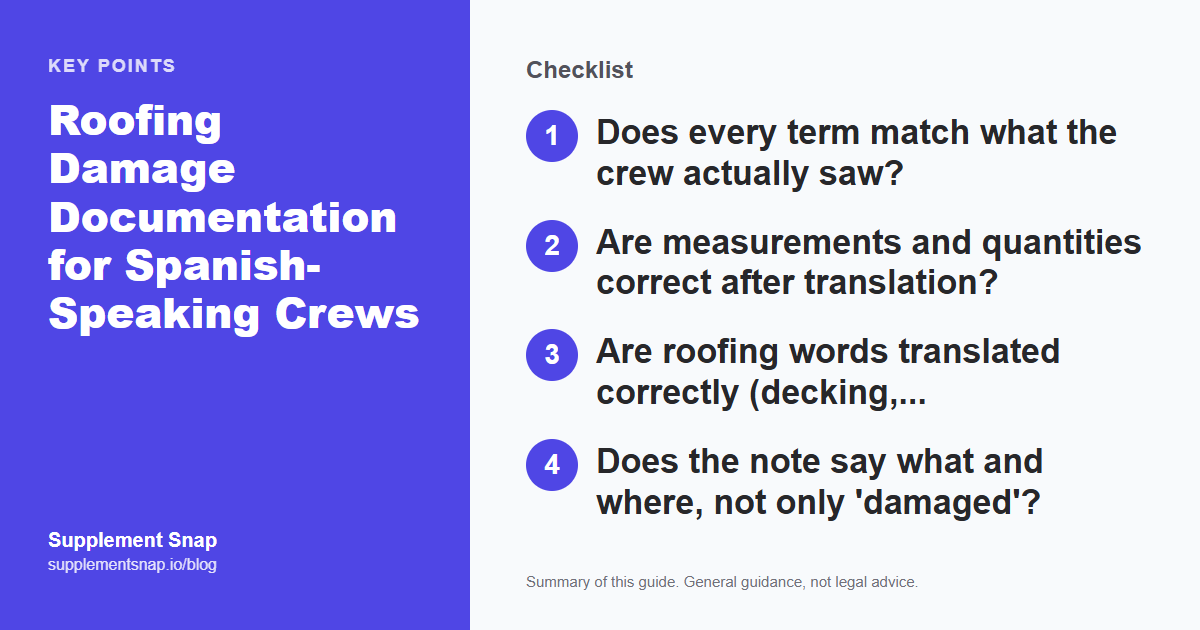
Translation can slip on trade terms. Check that decking, flashing, drip edge, ice and water shield and pipe boot come out as the words your adjuster uses. Check numbers and units. Check that the note says what and where and not only 'damaged'.
If the supplement is large or contested, have someone who speaks both languages read the English against the original. It takes a minute and protects the contractor's credibility.
Tips for better voice notes
Say what you see, then where it is, then how big. For example: what the damage looks like, which slope or area, and roughly how far it runs.
Say why it was not visible before tear-off when that is true.
Speak slowly and clearly, and move away from saws and nail guns if you can.
Include numbers and units out loud, such as how many sheets or how many linear feet.
Avoid guessing at causes you did not see.
Check the English before it goes to the adjuster
Where Supplement Snap fits, and where it does not
Supplement Snap helps your crew capture notes in their own language and drafts the explanation for you to review. It does not guarantee a correct translation, replace a bilingual reviewer or decide what your carrier will accept.
Your first project is free, so you can test the voice and translation flow on one real job. Paid plans are Starter at $99 per month, Team at $199 and Pro at $299. See the feature walkthrough, a sample report and the pricing page. For what to photograph, use the photo documentation checklist.
Translation is a draft
Speech recognition and AI translation can both make mistakes, especially with trade terms, accents and background noise. Treat the English text as a draft that a person reviews. The contractor is responsible for what the adjuster receives.
Frequently asked questions
Can roofing crews dictate damage notes in Spanish?
In Supplement Snap, yes. The language picker includes Spanish, and a non-English note is translated to English for the report. Accuracy depends on the device's speech recognition and the translation, so review the English.
Is the translation accurate?
We do not publish accuracy figures. Speech recognition and AI translation can both make mistakes, especially with trade terms and background noise. Treat the English as a draft and have it reviewed.
Which other languages are supported?
The app's language list includes English, Spanish, Portuguese, French, Polish, Russian, Ukrainian, Vietnamese and Chinese. Check the app for the current list.
Do adjusters accept notes that were translated?
Adjusters read the English text in your report. What matters is that it is accurate and specific. Ask your adjuster if they have requirements for documentation.
Does using voice notes make a supplement more likely to be approved?
No tool can promise that. Approval depends on the claim, the policy, the carrier and your documentation. Clear, detailed notes help the adjuster understand the finding.
References & Resources
Free tools and resources
Ready to streamline your supplement process?
Supplement Snap helps your crew capture hidden damage during tear-off and generate adjuster-ready reports in minutes.
Written by
Kelvin Spratt
Founder, Supplement Snap
Kelvin builds software for roofing contractors who are tired of leaving supplement money on the table. His background in software development and insurance restoration workflows drives everything Supplement Snap does.