How to Track Whether Your Roofing Supplements Are Working
Kelvin Spratt
Founder, Supplement Snap · October 25, 2026 · Updated October 25, 2026
Key Takeaways
Track a few simple numbers to see if your supplement process works: time to send, paid versus asked and follow-ups. Free tracker included.
Preparing a supplement? Use the free checklist so nothing is missing when you submit.
The short answer
You cannot tell whether supplements are worth your time, or whether new software is paying off, without a few numbers from your own jobs. Track five things on every insurance job: whether a supplement was sent, how many days after tear-off, how much you asked for, how much was paid, and why anything was denied. Three months of that tells you more than any published average.
Disclosure: we make Supplement Snap, which helps roofing crews document damage found at tear-off and export a report. It does not decide coverage, negotiate claims or guarantee approval. This page is general guidance, not legal or claims advice.
Free download
Roofing supplement tracker
One line per supplement: claim, carrier, date sent, follow-up date, status and amount asked, with a weekly checklist.
Fillable PDF: open it in a PDF reader such as Adobe Acrobat Reader to type into the blanks. Some phone and browser previews cannot.
See all free roofing templates →
No email or sign-up needed. General guidance, not legal advice. Adjust it to your carrier's, client's and state's requirements.
The five numbers
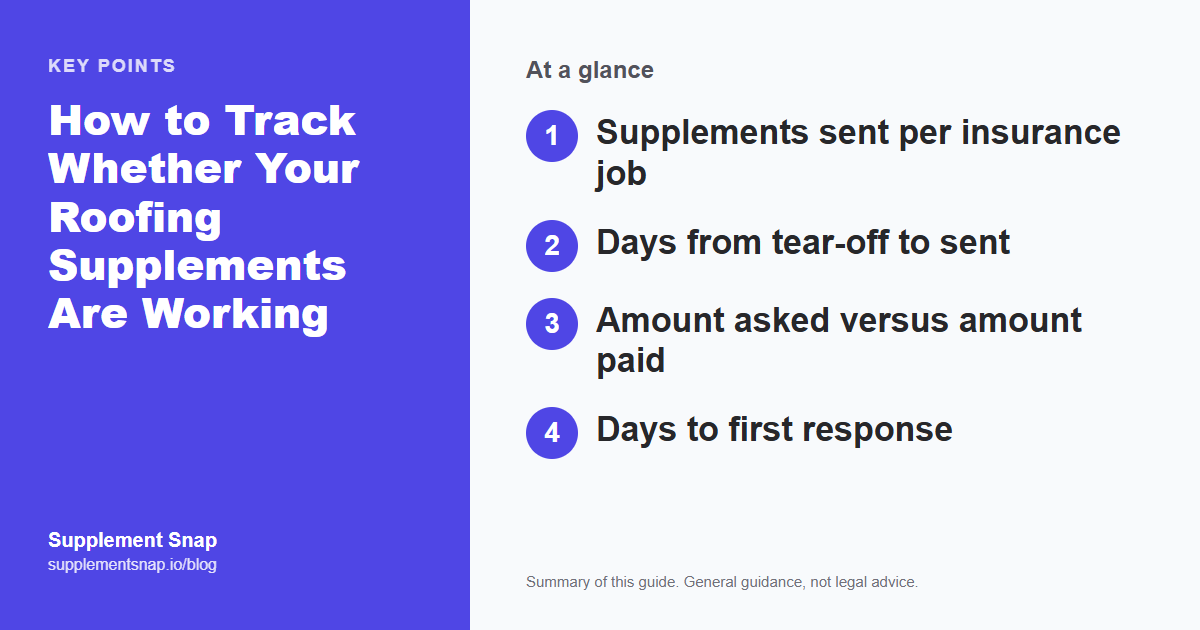
The table lists them. None needs special software. A spreadsheet, a printed page or our free tracker works. What matters is that you write them down every time, at the moment they happen, not from memory at the end of the month.
| Feature | Why it matters |
|---|---|
| Supplements sent per insurance job | Shows how often hidden damage is actually being documented and requested |
| Days from tear-off to sent | Shows whether the package goes out while the damage is fresh |
| Amount asked versus amount paid | Shows what the carrier actually accepts, in your market, on your jobs |
| Days to first response | Shows where follow-up is needed |
| Supplements denied and why | Shows what documentation was missing |
Keep the numbers in one place.
Supplement Snap keeps each project's findings and report together, so your tracker only needs the status. Your first project is free.
How to record them
Use one line per supplement. Our supplement tracker template has columns for claim, carrier, date sent, follow-up date, status and amount asked. Add two columns of your own: the date of tear-off and the amount paid.
When the carrier responds, write the date and the result. If part was denied, write the reason in a few words, such as no photo of the location or quantity not shown.
What to look for after a month
Count jobs with hidden damage and compare with supplements actually sent. A gap means findings are being missed or not sent. Look at days from tear-off to sent: long gaps usually mean the documentation is being rebuilt later in the office. See how to write supplements faster.
Then look at paid versus asked. A big gap may mean quantities or photos were not convincing, or that you asked for items the policy does not cover.
Measure your own jobs, not an industry average
No average from another company tells you how your process is doing. A few numbers tracked on your own jobs for three months tell you much more.
What to look for after three months
Patterns appear: one carrier that responds slowly, one finding type that is often denied, one crew that always sends complete packages. Use them. Send the strong crew's packages to the others as examples. Change the checklist for the weak spot. Raise problem patterns with the carrier contact in writing.
If you tried new software during this time, compare the three months before and after on the same five numbers. Use our ROI calculator with your real figures.
What not to conclude
A single denial does not mean the process is broken. Carriers decide, and one job can go either way. Look for patterns across many jobs. Also be careful comparing months: a hail season and a quiet month are not comparable. Compare like with like.
Keeping it light
The aim is a few minutes a week, not a reporting project. Put one person in charge, review the numbers once a month, and change one thing at a time. If you stop recording, you lose the advantage, so make it part of sending the supplement.
A sample month (fictional numbers)
Ten insurance jobs, six with hidden damage, five supplements sent, an average of three days from tear-off to sent. Asked: five requests listed in the tracker. Paid in full: two. Paid in part: one. Denied: two, both noted as missing photo of location.
From that month you would learn that one job had damage that never went out, that three days is slower than you want, and that location photos are the weak spot. All numbers here are invented to show the method, not a benchmark.
Turning numbers into changes
Pick one weak number and change one thing. If location photos are the problem, add a wide-photo step to the crew checklist. If days to send is long, set a same-day rule. Then look at the same number next month. Changing five things at once makes it impossible to see what helped.
Frequently asked questions
What should I track for roofing supplements?
Whether one was sent, days from tear-off to sent, amount asked, amount paid, and reasons for any denial.
Do I need software to track it?
No. A spreadsheet or a printed tracker works. Software helps when many people are involved.
How long before the numbers mean anything?
Three months of consistent records is a reasonable start, longer if you do few jobs.
What is a good paid-to-asked ratio?
There is no universal number. Compare your own over time and across carriers.
How do I know if new software is helping?
Compare the same five numbers before and after, on similar kinds of jobs.
Should I track time spent too?
If you want to value time savings, note the minutes spent building each report for a few jobs before and after a change.
References & Resources
Free tools and resources
Ready to streamline your supplement process?
Supplement Snap helps your crew capture hidden damage during tear-off and generate adjuster-ready reports in minutes.
Written by
Kelvin Spratt
Founder, Supplement Snap
Kelvin builds software for roofing contractors who are tired of leaving supplement money on the table. His background in software development and insurance restoration workflows drives everything Supplement Snap does.
More Articles
Roofing Supplement Tracker Template (Free PDF, Fillable, Word)
Read more →
Roofing Supplement Follow-Up Log: Track Submissions and Adjuster Responses
Read more →
Is Roofing Supplement Software Worth It? The Break-Even Math
Read more →
How Roofing Contractors Work Insurance Claims: A Step-by-Step Guide
Read more →