Is Roofing Supplement Software Worth It? The Break-Even Math
Kelvin Spratt
Founder, Supplement Snap · October 25, 2026 · Updated October 25, 2026
Key Takeaways
How to work out whether supplement software pays for itself: the break-even formula, the inputs you need and the honest limits of any estimate.
Preparing a supplement? Use the free checklist so nothing is missing when you submit.
The short answer
Software is worth it when the extra money it helps you recover, plus the time it saves, is more than it costs. You can check this with simple arithmetic and your own records. No one can promise a result, because carriers decide and every job differs.
Disclosure: we make Supplement Snap, which helps roofing crews document damage found at tear-off and export a report. It does not decide coverage, negotiate claims or guarantee approval. This page is general guidance, not legal or claims advice.
The break-even formula
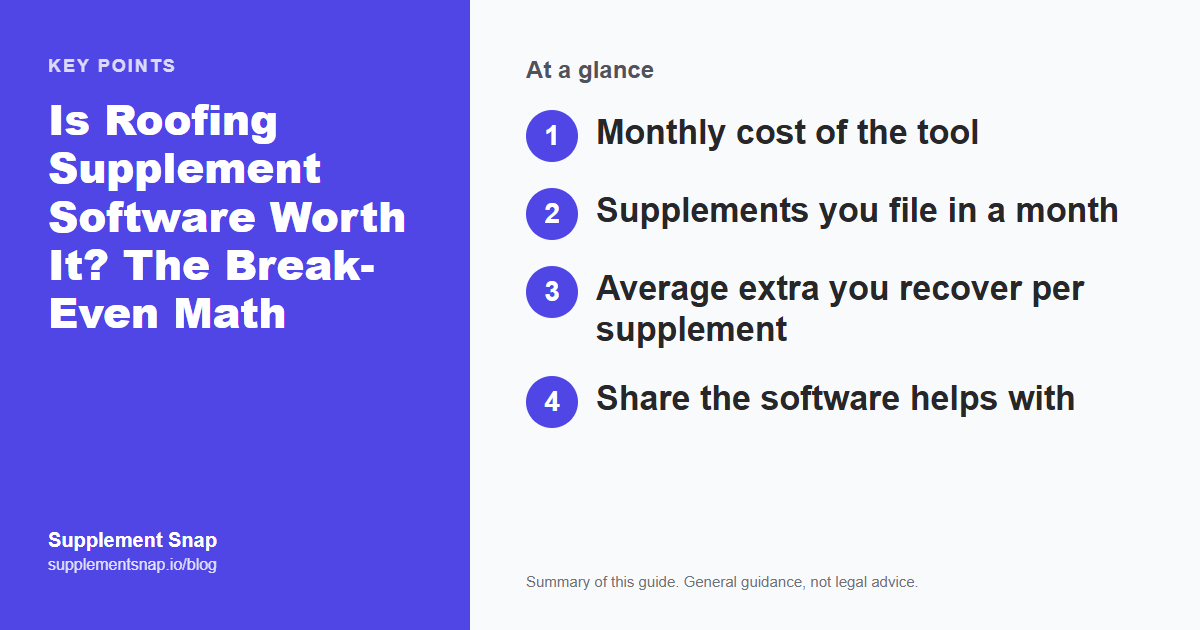
Break-even supplements per month = monthly cost divided by the average extra you recover per supplement. If a tool costs $99 a month and the extra you recover averages $400 per supplement, then $99 divided by $400 is about 0.25, so one such recovery every four months covers the monthly cost. Those are example numbers only. Use your own and check the vendor's current price, or try the ROI calculator.
| Feature | Where it comes from |
|---|---|
| Monthly cost of the tool | The price on the vendor's pricing page |
| Supplements you file in a month | Your own records |
| Average extra you recover per supplement | Your own records, not an industry average |
| Share the software helps with | Your honest estimate; start low |
Run the numbers on your own jobs.
Your first Supplement Snap project is free, so you can judge the report before you pay for anything.
What goes in
The table lists the inputs. Pull them from your records: how many supplements you sent last quarter, what you asked for, what was paid. If you do not track those, start with the free tracker.
The time side
Hours spent building reports, sorting photos and chasing details also cost money. Estimate how long a report takes now and how long it takes with a better process, and value the difference at your own rate. Be careful with this one, because faster is only worth it if the reports are as good.
Use your numbers
Averages from other companies do not describe your jobs. Use your last three months and treat the result as a rough guide, not a promise.
What software cannot do
It cannot make a carrier pay. It can help you present clearer documentation. If you rarely find hidden damage, or you already have a process that works, the benefit may be small.
How to test cheaply
Use the free project or trial on one real job and compare the output with your current process. Then decide. Our guide to free supplement software and the cost comparison give more detail.
Three worked scenarios (fictional numbers)
Scenario A: a company sends 2 supplements a month, recovers about $300 extra on each when it does, and thinks software helps with half of them. Benefit is 2 x 50% x $300 = $300 a month before any time savings. Against a $99 plan, that is a gain of $201 on paper.
Scenario B: a company sends 1 supplement a month and recovers $150 extra. Benefit is $75 if software helps with half, which is below a $99 price. Time savings would have to make up the difference.
Scenario C: a company sends 12 supplements a month, recovers $400 on each, and software helps with a quarter of them. Benefit is 12 x 25% x $400 = $1,200.
The numbers are invented. Run your own.
The hidden costs of switching
Software has a learning curve. Allow a few jobs for the crew to get comfortable, and expect some reports to take longer at first. Also consider where the data lives, how you export it and what happens if you stop paying. Ask any vendor, including us, about export before you commit.
Alternatives that cost less
A tracker, a template and a crew checklist cost nothing and fix a lot of problems. They do not draft descriptions or build the PDF for you, so they take more of your time. If your volume is low, they may be enough. If your time is the constraint, software may be worth testing.
How to run a fair test
Pick three real jobs. Do the first with your current process and time it. Do the second with the software and time it. Compare the finished reports, side by side, as a reviewer would. Decide on the quality of the output and the time, not on the demo.
Frequently asked questions
How do I calculate the return on supplement software?
Compare its monthly cost with the extra you recover and the time you save, using your own records.
What is a good break-even?
That depends on your volume and averages. Fewer supplements needed to break even is better.
Does software guarantee more money?
No. Carriers decide. Software helps organize and present documentation.
What if I only file a few supplements a year?
The benefit may be small, and a free tracker and template may be enough.
Should I trust a vendor's ROI claims?
Treat them as examples. Use your own data.
Can I trust a calculator's result?
Only as much as the inputs. Use real numbers from your own records and test the assumptions with a conservative estimate.
What if my supplements are mostly denied?
Look at why first. If documentation is the reason, better capture may help. If the reason is coverage, software will not change it.
References & Resources
Free tools and resources
Ready to streamline your supplement process?
Supplement Snap helps your crew capture hidden damage during tear-off and generate adjuster-ready reports in minutes.
Written by
Kelvin Spratt
Founder, Supplement Snap
Kelvin builds software for roofing contractors who are tired of leaving supplement money on the table. His background in software development and insurance restoration workflows drives everything Supplement Snap does.