Hail Damage Roof Insurance Claims: What Contractors Should Document
Kelvin Spratt
Founder, Supplement Snap · October 23, 2026 · Updated October 23, 2026
Key Takeaways
What roofing contractors should document on a hail damage insurance claim: signs of hail damage, test squares, date of loss and the photos adjusters need.
Preparing a supplement? Use the free checklist so nothing is missing when you submit.
The short answer
On a hail damage claim, contractors should document what hail did to the roof and the property, where it did it, and when it happened. That means labeled photos of impacts on each slope, evidence on soft metals and nearby items, notes on the roof's age and condition, and a record of the date of loss.
The insurer decides whether the damage is covered and how it is measured. Your documentation helps the adjuster see what you saw. This guide is general information, and carrier standards vary.
Free download
Roof damage report template
Job details, roof summary, numbered findings, recommendations, a photo index and a photo checklist.
Fillable PDF: open it in a PDF reader such as Adobe Acrobat Reader to type into the blanks. Some phone and browser previews cannot.
See all free roofing templates →
No email or sign-up needed. General guidance, not legal advice. Adjust it to your carrier's, client's and state's requirements.
What hail damage looks like
Hail damage on asphalt shingles generally shows up as impact marks, bruising or loss of granules that exposes the mat. On metal components, it can appear as dents. Hail also damages items around the roof, which can help show that a storm reached the property.
Not every mark is hail. Wear, blistering, foot traffic, manufacturing issues and other events can leave similar-looking marks. A careful record separates what you can tie to hail from what you cannot.
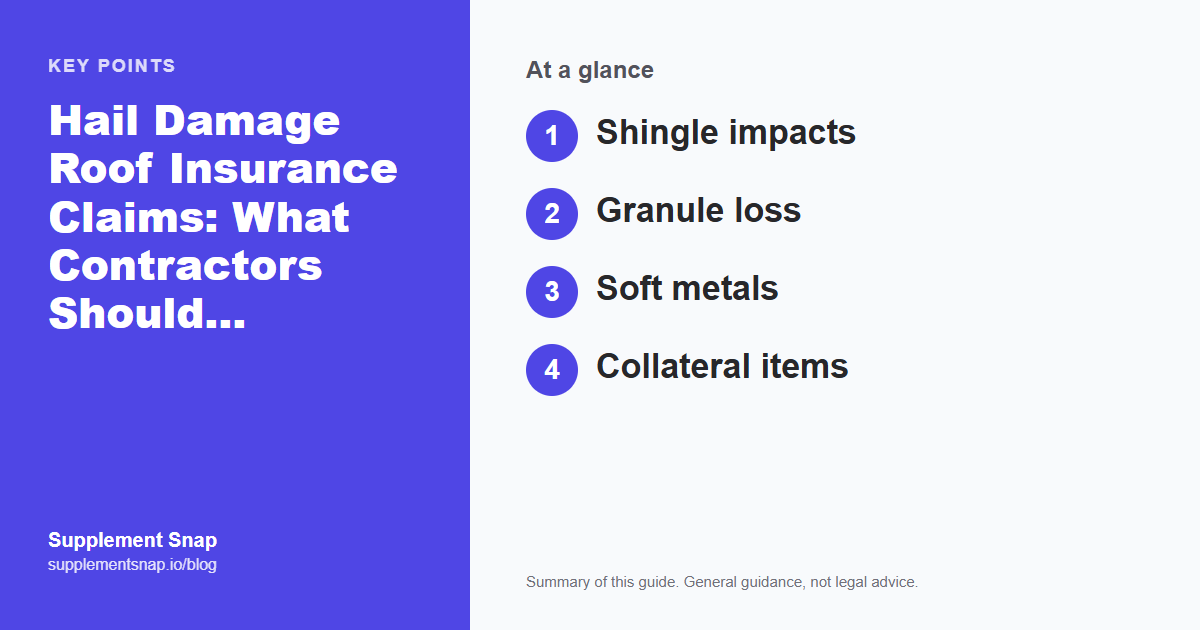
| Feature | What to record |
|---|---|
| Shingle impacts | Location, size and pattern of marks, compared across slopes |
| Granule loss | Exposed mat or bare spots, with a close-up and a wide shot |
| Soft metals | Dents on vents, flashing, drip edge and gutters |
| Collateral items | Damage to siding, fences, AC units or window screens, where present |
| Roof condition | Approximate age and general wear, recorded honestly |
Capture this on the roof, not from memory.
Supplement Snap lets your crew take photos and voice notes at tear-off and drafts a report you review before sending. Your first project is free.
Test squares and thresholds
Some carriers evaluate hail damage by choosing a representative area of each slope, often called a test square, and counting impacts within it. The count that triggers repair or replacement varies by carrier and guideline.
If a test square is used, photograph its boundaries and the impacts inside it. If the adjuster used one, ask what standard applies. Knowing the method lets you document in a way that matches how the claim is being evaluated.
Thresholds vary by carrier
Some carriers evaluate hail with test squares and count impacts per square. The number that counts as damage differs between carriers and guidelines, so ask the adjuster what standard applies to your claim.
Verify the date of loss
Insurance coverage ties to a date of loss, so it helps to know when the storm happened. Public weather resources can help you confirm that hail occurred in the area on a given date. The National Weather Service and NOAA's Storm Events Database are common references.
Record the date you are working from and where you found it. This is supporting context. The carrier and policy determine how the date of loss is used.
Photo and notes checklist
The checklist covers the shots that make a hail report easy to follow. Take wide photos first, then close-ups, and label each one with the slope or component. Compare damaged slopes with less affected ones so the pattern is clear.
For more detail on what to capture, see the hail damage roof inspection guide and the photo documentation checklist.
Hail claim photo checklist
Common mistakes on hail claims
These slow claims or weaken credibility:
Treating all wear as hail: Record old wear separately.
Missing the wide shot: A close-up with no location is hard to place.
No scale: Without one, size is a guess.
Vague notes: Say how many, where and how large.
Ignoring soft metals: They are quick to photograph and can support the overall picture.
Guessing at coverage: That decision belongs to the carrier.
Where Supplement Snap fits
Supplement Snap lets a crew capture labeled photos, roof areas and notes as they work, then builds a report you can send to the adjuster. It does not decide coverage or guarantee approval. See the sample report and the free checklist.
Frequently asked questions
What should a contractor document on a hail damage claim?
Impacts on each slope, soft-metal dents, collateral damage, the roof's age and condition, and the date of loss, all with labeled photos and notes.
What is a test square in a hail inspection?
A representative area of a slope used by some carriers. Impacts within it are counted, and the threshold varies by carrier and guideline.
How do I confirm when hail happened?
Public weather resources such as the National Weather Service and NOAA's Storm Events Database can help confirm hail in an area on a given date. Record the source.
Does documenting hail damage guarantee the claim is approved?
No. Coverage and approval depend on the policy, the carrier and the claim.
Can an adjuster deny a hail claim because the roof is old?
Roof age and condition can affect how a claim is evaluated and paid, depending on the policy. Review the policy terms for details.
References & Resources
Free tools and resources
Ready to streamline your supplement process?
Supplement Snap helps your crew capture hidden damage during tear-off and generate adjuster-ready reports in minutes.
Written by
Kelvin Spratt
Founder, Supplement Snap
Kelvin builds software for roofing contractors who are tired of leaving supplement money on the table. His background in software development and insurance restoration workflows drives everything Supplement Snap does.
More Articles
Shingle Matching on Roof Claims: What Roofers Should Know
Read more →
Hail Damage Roof Inspection: What Gets Missed and How to Document It
Read more →
How Insurance Adjusters Determine Roof Damage (and What Documentation Helps)
Read more →
Roofing Photo Documentation Checklist: What to Photograph at Tear-Off
Read more →