Shingle Matching on Roof Claims: What Roofers Should Know
Kelvin Spratt
Founder, Supplement Snap · October 25, 2026 · Updated October 25, 2026
Key Takeaways
When shingles are discontinued or colors no longer match, who pays? How matching works on roof claims, what varies by state, and how to document it.
Preparing a supplement? Use the free checklist so nothing is missing when you submit.
The short answer
Matching is the question of whether a repaired roof should look like the rest of it. If only part of a roof is replaced and the new shingles do not match the old ones, the homeowner may ask the carrier to pay for more. What the carrier owes depends on the state, the policy and the facts, so there is no single rule. Your job is to document the facts well.
Disclosure: we make Supplement Snap, which helps roofing crews document damage found at tear-off and export a report. It does not decide coverage, negotiate claims or guarantee approval. This page is general guidance, not legal or claims advice.
Free download
Roof damage report template
Job details, roof summary, numbered findings, recommendations, a photo index and a photo checklist.
Fillable PDF: open it in a PDF reader such as Adobe Acrobat Reader to type into the blanks. Some phone and browser previews cannot.
See all free roofing templates →
No email or sign-up needed. General guidance, not legal advice. Adjust it to your carrier's, client's and state's requirements.
Why the answer changes
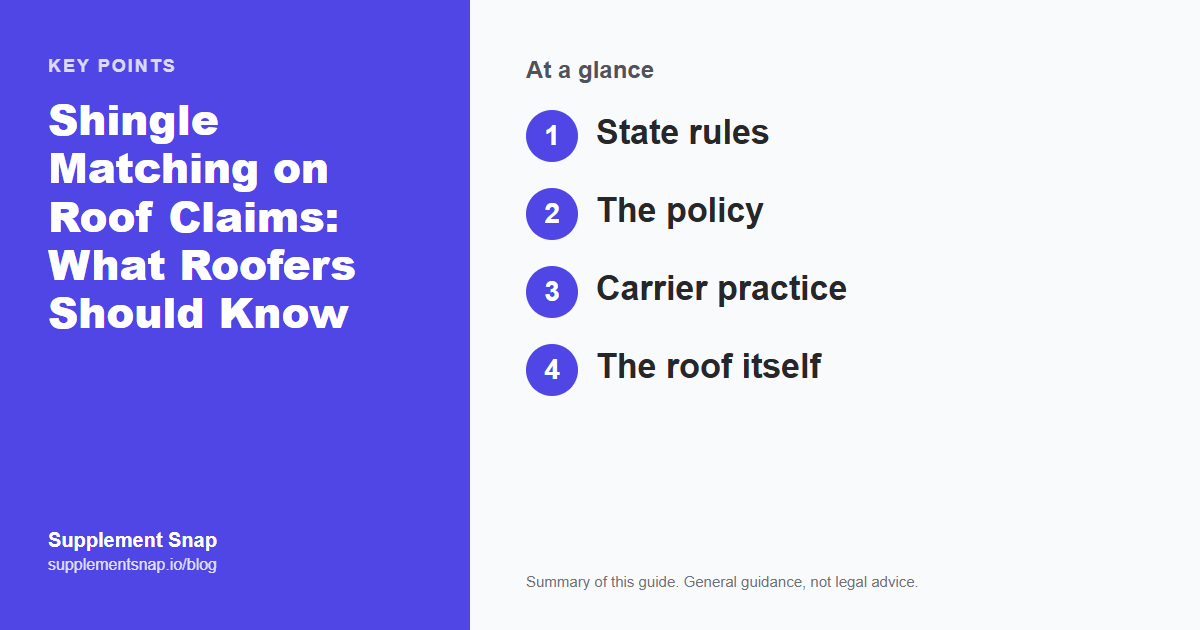
The table shows what varies. Some states say the repair should leave a reasonably uniform appearance. Others look at whether the mismatch can be seen from a normal viewing point. Some policies have endorsements that change the result. Do not assume the rule from the last state you worked in applies here.
| Feature | What can differ |
|---|---|
| State rules | Some states have rules or guidance about matching, written in different words; others have none |
| The policy | Wording and endorsements can add to or limit matching coverage |
| Carrier practice | Two carriers in the same state can treat the same situation differently |
| The roof itself | Age, weathering, discontinued products and slope layout affect what a fair match looks like |
Show the mismatch with evidence.
Supplement Snap helps your crew document the existing roof and what was found so your report shows the whole picture. Your first project is free.
What to document
Photograph the whole roof from several angles, including from the street, and every slope that would be affected. Take close photos of the shingles that show color, wear and any maker's markings on a loose piece.
If the product is discontinued, record the maker, the line and the color, and keep any written confirmation from the manufacturer or a supplier that it is no longer available. A supplier's printout of available colors, dated, is stronger than a verbal note.
Repairability and brittle shingles
On older roofs, a shingle may crack when lifted, which is relevant to whether a spot repair is practical. If you test a few shingles to see whether they can be lifted without breaking, document it with photos and notes. Present it as what you observed on this roof, not as a general rule.
Do not promise a full replacement
A homeowner who hears that matching means a whole new roof may be told something different by the carrier. Say what you can show, what the policy and your state say, and that the carrier decides.
How to present it
Put the matching question in its own section of the report: the existing product, what is available, the photos from each angle and the slopes involved. State what you observed and what you are asking for. Building codes, policy wording and carrier practice vary by state, county and policy. Confirm the details for your job with the local building department and the claim documents.
If your state publishes guidance on matching, link it. Your state's insurance department is a good source, and the NAIC lists them.
Talking with the homeowner
Be clear about what you cannot promise. You can explain what you see and how you will document it, and you can tell the homeowner to ask their carrier about matching coverage under their policy. In many states a contractor should not advise on coverage or negotiate the claim, so keep to your own scope of work.
A practical way to organize the evidence
Treat matching like any other finding. Give it a number and a short description, then attach the evidence in the same order each time: a wide photo showing the slopes, a close photo of the existing shingle, a photo of the replacement sample next to it, then any written confirmation about availability. A reviewer who sees the same order on every job learns where to look and what is missing.
Samples and side-by-side photos
If you can get a sample of the closest available product, photograph it in daylight next to an existing shingle from the same roof. Use the same angle and the same lighting. Phone cameras change color depending on light, so take more than one photo and avoid shadows. Say in your note that color on a screen may differ from color in person.
Layout of the roof matters
Roofs with several slopes that are visible from the same point can raise different questions than roofs where each slope is seen separately. A simple sketch or an annotated aerial image that shows which slopes are visible from the street, the yard and the neighbor's property is useful. You are describing what the eye sees, not predicting what the carrier will decide.
Age and weathering
A thirteen-year-old roof does not look like new shingles of the same color. Weathering, granule loss and fading are normal. Photograph the existing roof honestly. If you claim a mismatch, the reviewer will compare your photos with the sample and with the age of the roof, so overstating it hurts the credibility of your other items.
Where the homeowner comes in
Matching is a coverage question as much as a documentation question. The homeowner can ask the carrier or the agent how the policy and the state treat matching, and can ask the state insurance department for a plain-language explanation. A contractor can give the homeowner the photos and measurements to bring to that conversation.
Frequently asked questions
Does insurance have to replace the whole roof to match?
Not necessarily. It depends on the state, the policy and the facts. Some situations lead to a full replacement and some to a repair of the damaged slopes only.
What if the shingles are discontinued?
Document the product and keep proof it is no longer available. That is evidence for the carrier to consider, not a guarantee of payment.
Is there a federal rule on matching?
No. Matching is mostly handled by state rules, policy wording and carrier practice.
Where can I find my state's rules?
Start with your state insurance department. The NAIC keeps a list of them.
Should a contractor argue matching with the carrier?
Document the facts and give them to the homeowner and carrier. Whether a contractor can discuss coverage or negotiate depends on state licensing rules.
Can a contractor decide that a mismatch requires a full replacement?
No. A contractor can document the mismatch and the roof layout. The decision rests with the carrier under the policy and the state's rules, and in a dispute with the process the policy and state law provide.
Should I include a sample in the package?
A photo of a sample next to the existing shingle is usually enough. Keep the physical sample in case the carrier asks to see it.
References & Resources
Free tools and resources
Ready to streamline your supplement process?
Supplement Snap helps your crew capture hidden damage during tear-off and generate adjuster-ready reports in minutes.
Written by
Kelvin Spratt
Founder, Supplement Snap
Kelvin builds software for roofing contractors who are tired of leaving supplement money on the table. His background in software development and insurance restoration workflows drives everything Supplement Snap does.
More Articles
Does Insurance Cover Roof Replacement? What Contractors Should Tell Homeowners
Read more →
Can a Roofer Talk to the Insurance Company? What Contractors May and May Not Do
Read more →
Roofing Supplement Denied? Here's What to Do Next
Read more →
Hail Damage Roof Insurance Claims: What Contractors Should Document
Read more →