Insurance Lowball Roof Estimate: What Roofers and Homeowners Can Do
Kelvin Spratt
Founder, Supplement Snap · October 25, 2026 · Updated October 25, 2026
Key Takeaways
The carrier's roof estimate seems too low. Learn how to compare line items, document what is missing, and request a reinspection or supplement properly.
Preparing a supplement? Use the free checklist so nothing is missing when you submit.
The short answer
When an estimate seems low, the first step is to find out why. Compare the carrier's line items with the work you would do, check the quantities, and separate differences in scope from differences in price. Then document what is missing and send it through the carrier's process, usually a supplement or a reinspection request.
Disclosure: we make Supplement Snap, which helps roofing crews document damage found at tear-off and export a report. It does not decide coverage, negotiate claims or guarantee approval. This page is general guidance, not legal or claims advice.
Free download
Roofing supplement template
The five-part package: cover page, findings summary, findings with photo numbers, line items and sign-off, plus a before-you-send checklist.
Fillable PDF: open it in a PDF reader such as Adobe Acrobat Reader to type into the blanks. Some phone and browser previews cannot.
See all free roofing templates →
No email or sign-up needed. General guidance, not legal advice. Adjust it to your carrier's, client's and state's requirements.
Compare line by line
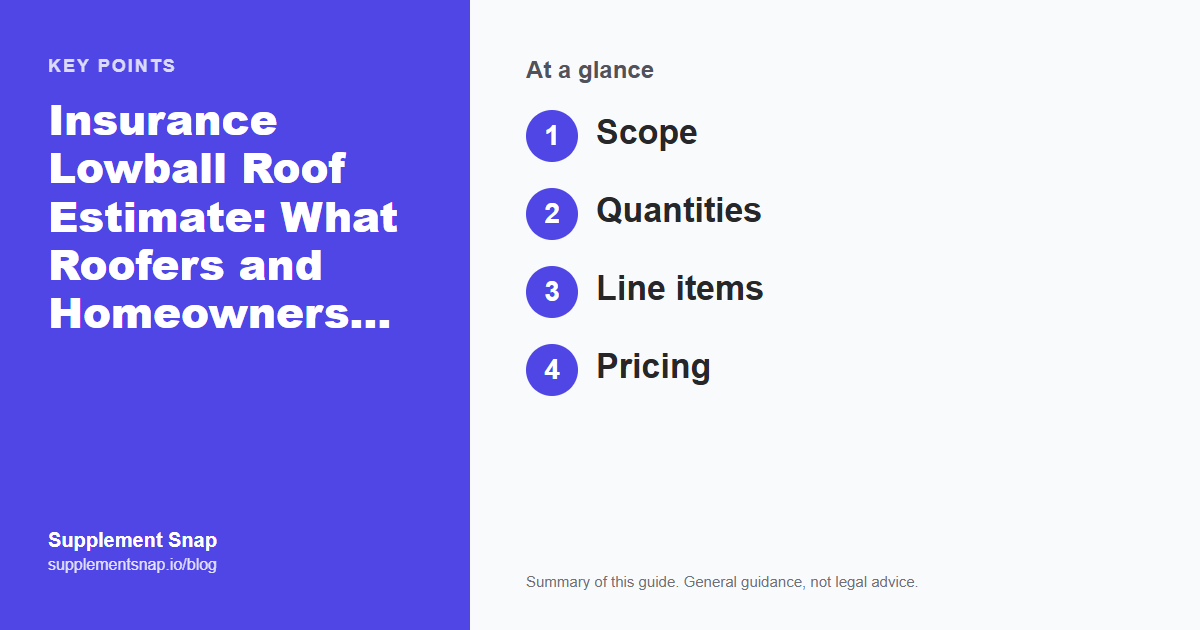
The table lists places to look. Put the carrier's estimate next to your own and mark each difference as scope, quantity or price. Differences in scope and quantity are the ones you can back with photos and measurements.
| Feature | Where to look |
|---|---|
| Scope | Are all slopes and components in the estimate? |
| Quantities | Do measurements match the roof? |
| Line items | Are drip edge, underlayment, flashing and similar items listed? |
| Pricing | Is the price list current for your area and date? |
| Policy limits | Deductible, depreciation and coverage terms that change the payment |
Turn disagreement into documentation.
Supplement Snap helps your crew capture the proof a carrier can review. Your first project is free.
Understand depreciation and the deductible
Part of the gap between a quote and a payment can come from the deductible and from depreciation that may be recoverable later. Those are policy matters. Explain them to the homeowner as questions for the carrier and avoid predicting the outcome.
Documenting what is missing
For each difference, take photos, record measurements and write a short factual note. Number the items. If the roof was not fully inspected, a reinspection request may fit better than a supplement.
Low is not the same as wrong
An estimate can be lower than a quote for reasons that are correct, such as depreciation or the deductible. Compare scope and quantity before you call it wrong.
Choosing the next step
Use a supplement for items found or missed that you can document. Use a reinspection when you think the original inspection missed visible damage. If you and the carrier still disagree on the amount of loss, the policy may offer an appraisal process. Read the policy and ask the carrier.
Keep it professional
Stay factual and polite in writing, keep copies, and note dates. Contractors should be careful about negotiating coverage for a homeowner because rules differ by state. Policy wording, state rules and carrier practice vary, so confirm the details for your job.
A side-by-side comparison you can build in ten minutes
Make a table with four columns: item, the carrier's quantity, your quantity, and the reason for any difference. Fill it row by row from the carrier's estimate. Typical rows are tear-off, underlayment, shingles, starter, ridge cap, drip edge, flashing, vents, decking, permit, disposal and any charges for pitch or height.
A difference with a reason, such as the carrier lists 28 squares and you measured 31 because of the dormer, is something the reviewer can check. A difference with no reason invites a reply that says the estimate stands.
What a reasonable gap looks like
Two honest measurements of the same roof rarely match to the foot. Small differences in quantity can come from where each person measured, waste factors or rounding. Focus on differences that are large, that involve a missing item, or that change a category such as a layer of tear-off or a pitch range. Do not build a request around a one percent difference.
Questions to ask the homeowner
Ask whether they have the full estimate with all pages, the policy declarations page, and any letters from the carrier. Ask which deductible applies and whether the policy pays on actual cash value or replacement cost. Those answers explain a lot of the gap between a quote and a payment. They are also the homeowner's to ask the carrier, and a contractor should not interpret the policy for them.
Writing the request
A short cover note works best: the claim number, that you reviewed the estimate against your measurements, the number of differences, the total requested and the list attached. Keep tone neutral. Attach the comparison table, the photos and the measurements. Then set a follow-up date.
Frequently asked questions
Why is the insurance estimate lower than my contractor's quote?
Differences can come from scope, quantities, prices, depreciation or the deductible. Compare line by line to find out.
Can I dispute an insurance estimate?
You can ask the carrier to review it with new documentation. The policy may have other dispute steps.
What is a supplement?
A request for additional payment for items found or missed, with documentation.
When should I ask for a reinspection?
When you think visible damage was missed or measured differently in the original inspection.
Should the contractor argue with the adjuster?
Provide documentation. Whether a contractor can negotiate the claim depends on state rules.
Is the carrier's first estimate final?
Not necessarily. Carriers commonly review additional documentation, and the policy may offer further steps if there is a disagreement. The process varies by carrier and state.
Should I send my own contractor quote as proof?
A quote shows what you would charge, but the carrier's review turns on scope, quantity and the policy. Evidence about the roof is usually more useful than a price alone.
References & Resources
Free tools and resources
Ready to streamline your supplement process?
Supplement Snap helps your crew capture hidden damage during tear-off and generate adjuster-ready reports in minutes.
Written by
Kelvin Spratt
Founder, Supplement Snap
Kelvin builds software for roofing contractors who are tired of leaving supplement money on the table. His background in software development and insurance restoration workflows drives everything Supplement Snap does.
More Articles
Roofing Supplement Denied? Here's What to Do Next
Read more →
How to Request a Reinspection on a Roof Claim (and When a Supplement Fits Better)
Read more →
The Appraisal Clause on a Roof Claim: How It Works
Read more →
Recoverable Depreciation on a Roof Claim: How It Works and How Contractors Help Get It Paid
Read more →