Roof Damage Repair: Contractor Guide to Identifying, Documenting, and Getting Paid
Kelvin Spratt
Founder, Supplement Snap · March 24, 2026
Hidden Damage Found
70-90%
Of insurance tear-offs reveal damage not in the original estimate
Key Takeaways
Contractor guide to roof damage repair: how to identify all damage types, document findings for insurance, navigate repair vs. replace decisions, and recover full value through supplements.
What is roof damage repair?
Roof damage repair encompasses any work needed to restore a roofing system that has been compromised by storms, age, water intrusion, structural movement, or other causes. For contractors, understanding the full scope of roof damage repair is essential because it directly affects how you estimate jobs, communicate with homeowners, and interact with insurance companies.
Roof damage can be visible or hidden. Visible damage includes missing shingles, obvious leaks, and cracked tiles that anyone can see from the ground. Hidden damage is concealed beneath the roofing surface and is only discovered during a detailed inspection or during tear-off. This hidden damage is where most contractors leave money on the table, because it represents legitimate repair costs that were not included in the original estimate.
Whether you are a contractor bidding a job, a homeowner evaluating repair options, or a roofing company managing insurance claims, this guide covers what you need to know about roof damage repair: the types of damage, how to assess them, when to repair versus replace, how insurance claims work, and how to document hidden damage for supplement recovery.
Storm Damage
Wind, hail, and debris damage from severe weather events. Usually covered by homeowner's insurance when properly documented.
Age-Related Wear
Curling shingles, granule loss, cracked tiles, and brittle materials from years of UV exposure and thermal cycling.
Water Damage
Leaks, moisture intrusion, decking rot, and mold caused by failed flashings, ice dams, or compromised shingles.
Flashing Failure
Corroded, separated, or improperly installed flashings around chimneys, walls, valleys, and penetrations.
Pipe Boot Failure
Cracked rubber seals around plumbing vents that allow water to enter around the pipe penetration.
Multiple Layers
Second or third layer of shingles installed over the original, adding weight and hiding underlying problems.
Types of roof damage
Roof damage falls into several categories, and most damaged roofs have problems from more than one category. Understanding each type helps you perform thorough inspections and write complete estimates.
Storm damage is the most common trigger for insurance-funded roof repairs. Wind lifts, creases, and tears shingles. Hail bruises shingle surfaces and displaces granules. Falling debris punctures materials and cracks decking. Storm damage is typically sudden and traceable to a specific weather event, which is important for insurance claims.
Age-related deterioration happens gradually over 15 to 30 years. Asphalt shingles curl at the edges, lose granules, become brittle, and eventually crack. Tile roofs develop hairline fractures. Metal roofs corrode at seams and fastener points. Age-related damage is generally not covered by insurance unless a storm event accelerates the deterioration.
Water damage results from any breach in the roofing system that allows moisture intrusion. This could be a failed pipe boot, corroded flashing, cracked sealant, or ice damming. Water damage is insidious because it often goes undetected for months or years, causing rotted decking, mold growth, and damaged insulation before anyone notices a visible leak.
Structural damage includes sagging roof decks, broken trusses, and shifted framing. This is less common but far more serious, often requiring engineering evaluation. Structural issues may result from overloading (heavy snow or multiple shingle layers), water damage that weakened framing members, or original construction defects.
Flashing failures occur at the most vulnerable points of any roof: the intersections. Wherever the roof meets a wall, chimney, valley, pipe, or vent, flashing creates the water-tight transition. When flashing corrodes, separates, or was never installed correctly, water finds its way in. Flashing failure is one of the most common supplement findings during tear-off.
Repair vs. replace: making the right decision
One of the most important decisions in roof damage repair is whether to repair the existing roof or replace it entirely. This decision affects the homeowner's cost, the insurance payout, and the scope of your project.
Repair makes sense when the damage is localized, the roof is relatively young (under 10 to 12 years), and the majority of the roofing system is still functional. A few missing shingles from a windstorm, a single area of hail damage, or a localized leak from a failed pipe boot can all be repaired without tearing off the entire roof.
Replacement is the right call when damage is widespread, the roof has reached or exceeded its expected lifespan, or the cost of repairs approaches 30 to 40 percent of replacement cost. Insurance companies typically authorize a full replacement when the adjuster determines that the damage affects enough of the roof surface that a repair would not restore the system to its pre-loss condition.
The gray area between repair and replacement is where thorough documentation matters most. If you inspect a roof and find scattered hail damage across all slopes, missing shingles on multiple elevations, and compromised flashings at every penetration, your documentation needs to tell that story clearly. The adjuster will authorize a replacement only if the evidence supports it.
For insurance claims, keep in mind that the repair versus replace decision is ultimately made by the insurance company based on their adjuster's findings. Your job is to provide thorough, accurate documentation of every damaged component so the adjuster has complete information to make that determination.
When to Repair
- Damage is localized to one area
- Roof is less than 10-12 years old
- Less than 30% of roof surface is affected
- Structural decking is still sound
- No active leaks or interior damage
- Budget is limited and damage is minor
When to Replace
- Damage is widespread across multiple slopes
- Roof is 15+ years old with general wear
- More than 30% of roof surface is compromised
- Decking damage is found in multiple areas
- Active leaks or interior water damage present
- Insurance is covering a full replacement
How insurance claims work for roof damage repair
Insurance claims are a critical part of roof damage repair because most significant roof repairs are funded by homeowner's insurance policies. Understanding this process helps you serve your customers better and ensures you get paid for all the work you perform.
The process typically follows these steps:
The homeowner discovers or suspects roof damage and files a claim with their insurance carrier. The carrier assigns a claim number and schedules an adjuster.
The insurance adjuster inspects the property and writes an initial estimate in Xactimate. This estimate covers the damage visible during their inspection.
The contractor reviews the adjuster's estimate and, if hired, begins the repair or replacement work.
During tear-off, the crew discovers hidden damage that was not visible during the adjuster's surface inspection. This is extremely common. Industry data shows that 70 to 90 percent of tear-offs reveal damage not included in the original estimate.
The contractor documents the hidden damage and submits a supplement to the insurance company. The supplement includes photos, a written narrative, and Xactimate line items for the additional work.
The insurance company reviews the supplement and, if properly documented, approves additional payment to cover the hidden damage repairs.
The supplement step is where most contractors either thrive or leave significant money on the table. A contractor who documents every hidden finding and submits professional supplements recovers $1,500 to $3,200 more per job than one who skips supplementing or submits weak documentation.
Roof Damage Repair Cost Breakdown (Typical 30 SQ Residential Roof)
Hidden damage discovered during repairs
Hidden damage is the most significant and most overlooked aspect of roof damage repair. When you tear off existing roofing materials, you expose everything that was concealed beneath the surface. And in the majority of cases, what you find changes the scope and cost of the repair.
The most common hidden damage findings include:
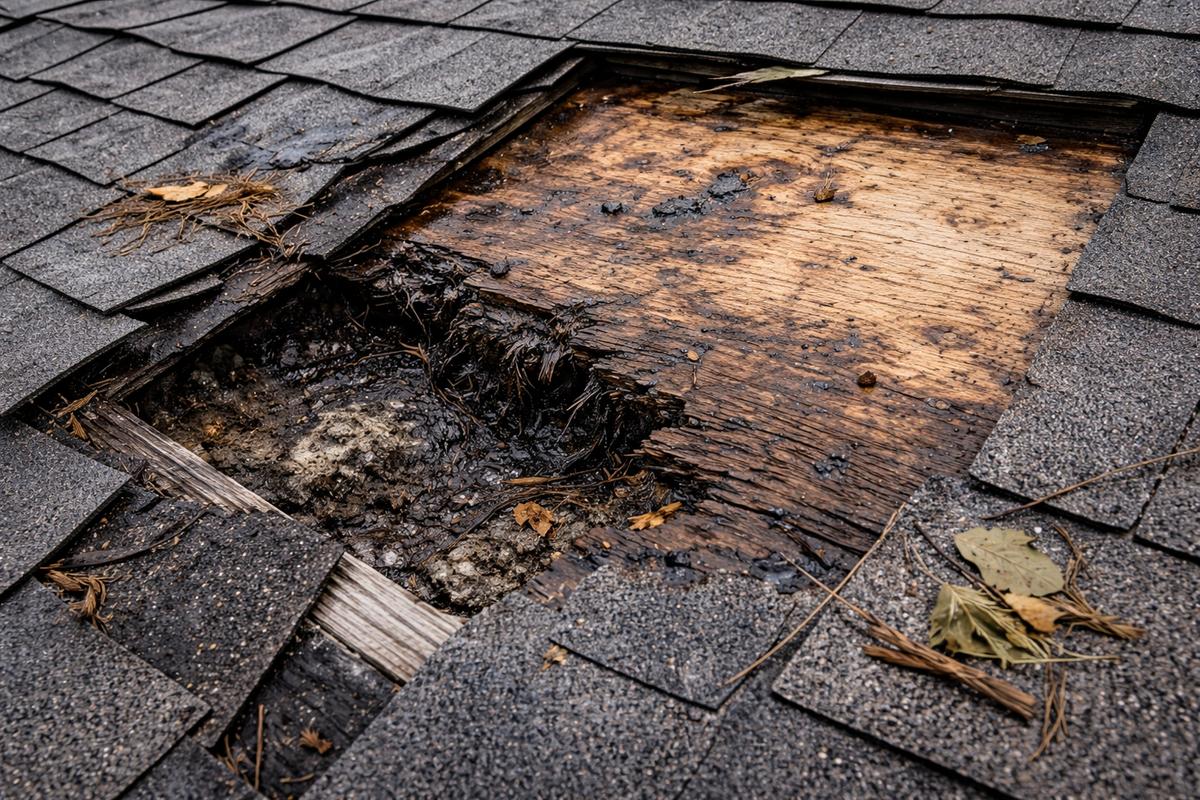
Rotted decking: Water that penetrated through damaged shingles or failed flashings has soaked into the plywood or OSB sheathing. The wood is soft, discolored, and structurally compromised. You cannot install new roofing over rotted decking. It must be cut out and replaced with new sheathing.
Deteriorated underlayment: The roofing felt or synthetic underlayment has torn, bunched, or disintegrated. In some cases, especially on older roofs, underlayment was never installed properly or is missing entirely in critical areas.
Failed flashing: Step flashing along chimneys and walls has corroded through. Valley flashing is bent or punctured. Counter flashing has separated from masonry. These failures are hidden beneath shingle courses and are not detectable from a surface inspection.
Damaged pipe boots: The rubber gaskets around plumbing vent pipes have cracked, split, or pulled away. These are technically visible from above, but the extent of damage (including water staining and rot around the penetration) is only apparent during tear-off.
Missing ice and water shield: Building codes require self-adhering ice and water membrane in valleys, at eaves (in cold climates), and around penetrations. Many roofs installed before current code requirements lack this protection. During a re-roof, installation is required by code.
Every one of these findings represents a legitimate cost that should be covered by the insurance claim. The key to recovering that cost is documentation: clear photos, detailed narratives, and accurate Xactimate line items submitted promptly after discovery.
Cost breakdown by damage type
Understanding the cost of common roof damage repairs helps contractors estimate accurately and helps homeowners set realistic expectations. These figures represent typical costs for a residential asphalt shingle roof and will vary by region, material, and roof complexity.
Shingle replacement for a localized area (5 to 10 squares) typically runs $1,200 to $2,000 including materials, labor, and disposal. A full tear-off and replacement on a 30-square roof ranges from $10,000 to $18,000 depending on material grade, roof pitch, and local labor rates.
Decking replacement costs $2.00 to $3.50 per square foot for plywood or OSB sheathing, including labor. A typical storm damage job might require 4 to 8 sheets of decking replacement, adding $700 to $1,400 to the project.
Flashing repair and replacement varies by type and location. Step flashing along a chimney or sidewall runs $8 to $15 per linear foot. Valley flashing replacement costs $10 to $18 per linear foot. Counter flashing at masonry walls is $12 to $20 per linear foot.
Pipe boot replacement costs $85 to $150 per boot depending on size and type. Most residential roofs have 2 to 4 pipe penetrations. Replacing all boots during a re-roof is standard practice and a common supplement item.
Ice and water shield installation costs $1.50 to $2.50 per square foot for the membrane plus labor. On a 30-square roof, valleys and eave areas might require 300 to 500 square feet of ice and water shield, adding $500 to $900 to the project.
Drip edge replacement runs $4 to $6 per linear foot. A typical residential roof has 150 to 250 linear feet of eave and rake edge, totaling $600 to $1,500 for full perimeter replacement.
Insurance Documentation Checklist
Documenting roof damage repair with Supplement Snap
The gap between what an insurance estimate covers and what the repair actually costs is real, and it exists on virtually every job. Closing that gap requires systematic documentation of hidden damage, professional supplement narratives, and accurate Xactimate coding. Doing this manually for every job is time-consuming and error-prone.
Supplement Snap streamlines the entire documentation workflow for roof damage repair. During tear-off, your crew captures each finding directly in the app: a photo tagged with the damage type and roof area, plus an optional voice note in any language. Spanish-speaking crews describe findings in their native language and the system translates to English automatically.
From those field captures, Supplement Snap generates:
Professional damage narratives written in the clear, specific language adjusters require
Xactimate line items with correct codes, proper units, and current regional pricing
An Xactimate-compatible CSV export the adjuster can import into their system
A branded PDF report with photos, narratives, and a complete findings summary
The result is a complete, professional supplement package ready to send to the adjuster within minutes of discovering hidden damage. No more lost photos, forgotten findings, or supplements that sit unfinished for weeks. Every hidden finding becomes a documented, submitted supplement, and you get paid for every repair you perform.
Need to write an inspection report? See our roof inspection report guide.
References & Resources
Ready to streamline your supplement process?
Supplement Snap helps your crew capture hidden damage during tear-off and generate adjuster-ready reports in minutes.
Written by
Kelvin Spratt
Founder, Supplement Snap
Kelvin builds software for roofing contractors who are tired of leaving supplement money on the table. His background in software development and insurance restoration workflows drives everything Supplement Snap does.